
Singapore has long been lauded for its safety and security, low corruptibility, clean government and governance, efficiency, liveability and other factors that make it a coveted place to live, work and play. Globally, it ranks highly in indices and benchmarks, including the inaugural Responsible Nations Index launched in January 2026, Least Corrupt Nation in Southeast Asia, Asian Cities Internationality Index, Global Cities Index, and World Competitiveness Ranking, to name a few.
Recent statistics, shared by Corrupt Practices Investigation Bureau (CPIB) in April 2026, reinforce that Singapore is deeply invested in keeping the country corruption-free. According to the data, the corruption situation here remains firmly under control, with the number of cases reported or being investigated remaining low in 2025.
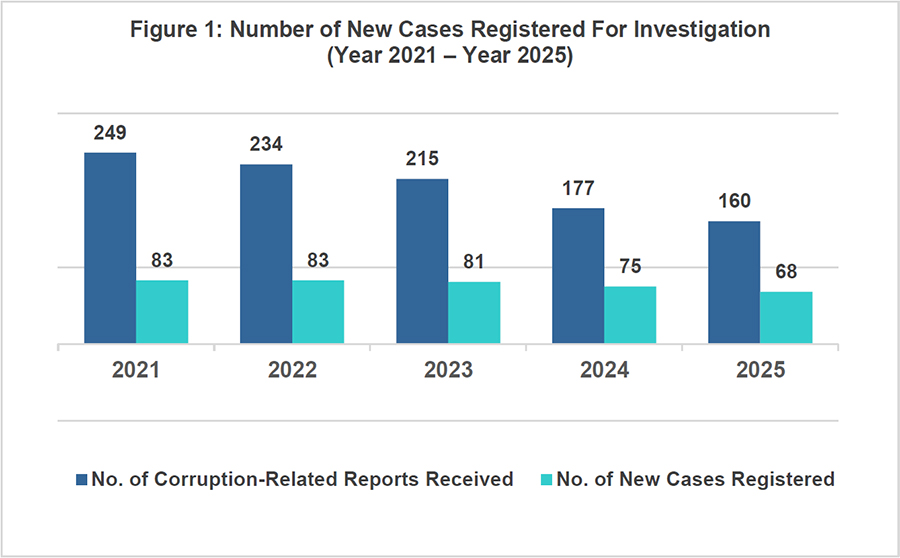
Last year, CPIB received 160 corruption-related reports, which is 10.6% fewer than the 177 reports received in 2024. Over the same period, CPIB registered 68 reports as new cases for investigation, down 10.3% from 75 in 2024 (Figure 1).
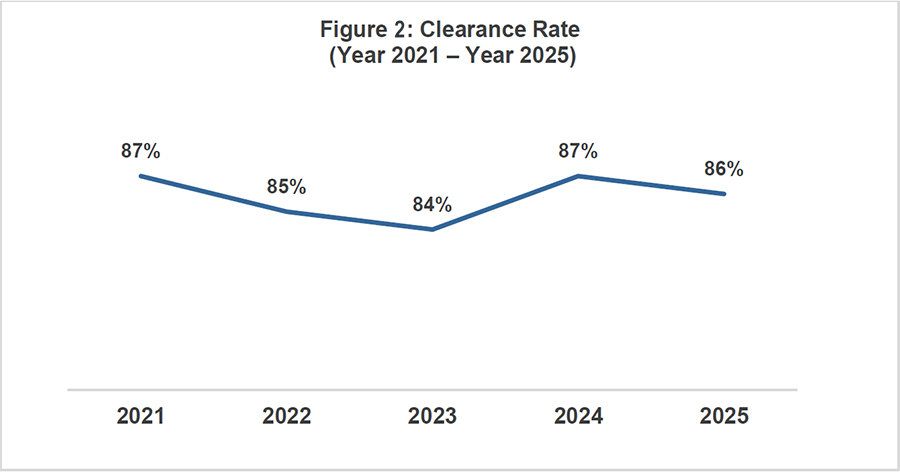
CPIB treats all reports seriously, regardless of whether the complainant is named or anonymous. In 2025, CPIB achieved a clearance rate of 86%1 (Figure 2). The conviction rate for its cases in 2025 was 100% (excluding withdrawal cases2). If withdrawal cases were included, the rate conviction rate was 91%.
Annually, CPIB commissions the Public Perception Survey3 to gauge the perceived level of corruption in Singapore, public understanding of corruption, and perception of the bureau’s effectiveness in curbing corruption.
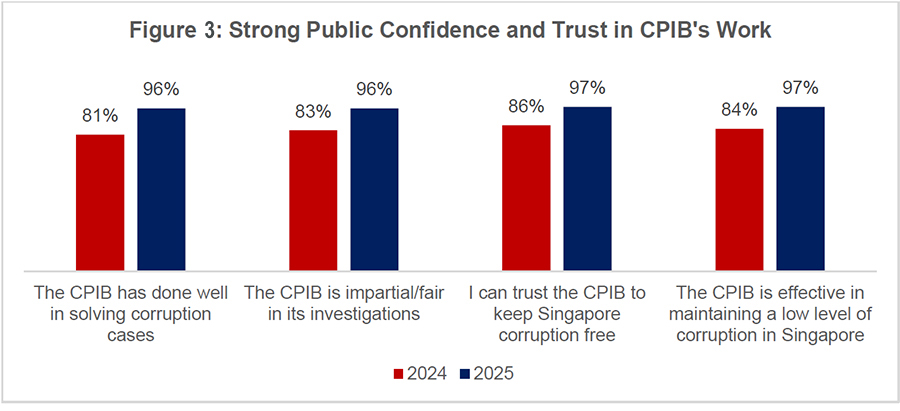
In the 2025 survey, 98% of respondents rated the corruption situation in Singapore as Good, Very Good, or Excellent. The top three factors contributing to the low corruption rate in Singapore were: political will to keep corruption under control, a zero-tolerance culture for corruption, and effective anti-corruption laws. There was significant improvement in the public confidence and trust in CPIB, compared with 2024. Over 95% of the respondents gave favourable responses (Strong Agree or Agree) to related questions in the survey (Figure 3).
Swift and decisive action by CPIB reflects Singapore’s strong commitment to a zero-tolerance approach towards corruption. This helps maintain a fair and trusted environment for businesses and the wider community. At the same time, preventing corruption is a shared responsibility. A vigilant public plays an important role, and together, these collective efforts help foster a culture of integrity where corruption has little room to take root.
CPIB continues to strengthen its prevention efforts across both the public and private sectors by working closely with partners to promote anti-corruption awareness. In the public sector, it collaborates with agencies to identify key risk areas and develop practical resources tailored to their operational needs. For example, CPIB worked with Certis to co-create a customised anti-corruption training module for Certis’ auxiliary police officers.
In the private sector, CPIB engages organisations through initiatives such as the Anti-Corruption Partnership Network (ACPN). On 5 September 2025, more than 160 professionals from financial institutions, audit and consultancy firms, professional bodies, and industry associations attended the annual ACPN event. The session, co-organised by CPIB and ISCA, provided a platform for participants to exchange ideas and best practices on how technology, professional ethics, and collaboration can further strengthen anti-corruption efforts.
Related articles on CA Lab:
1 Clearance rate refers to the total number of subjects CPIB has completed investigations on, out of the total number of subjects investigated by the bureau in the year.
2 Withdrawals refer to cases withdrawn after the accused was charged in court and before any court decision was made.
3 CPIB engages an independent research company to gauge public perception on corruption and the bureau. The survey, carried out annually since 2024, is conducted with a sample group of 1,000 individuals representative of the Singapore population profile.