

TAKEAWAYS
We are well-practised in assessing a company based on its financial data. That is now considered inadequate, and we can no longer bury our heads in the (fast-heating) sand.
Considerations to include extra-financial data – what we now term ESG (environmental, social and governance) or sustainability data – emerged decades ago. In 1974, the US SEC (Securities and Exchange Commission) evaluated the level of investor interest in environmental and civil rights disclosures and found that less than 1% of stocks and bonds were invested using ethical investing principles, while only 2% to 3% of shareholder proposals on environmental and social issues received support. The conclusion was that this type of disclosure did not meet the common information needs of investors.
But, like repressed emotions, they inevitably resurface, with greater ferocity. This year, the impact of climate change has become our collective lived experience. Extreme weather patterns are ratcheting up in frequency and intensity. With an increasing number of jurisdictions now mandating climate-related disclosures, this is the time to embrace the complex multidimensionality and short-term unattractiveness of ESG data.
In Singapore, sustainability reports for the financial year (FY) commencing on or after 1 January 2025 are starting to comply with the International Sustainability Standards Board-based (ISSB-based) climate-related disclosures (CRD), following the phased timeline set by the Singapore Exchange Regulation.
The Straits Times Index (STI) constituents have been tasked with pioneering this effort. Besides Scope 1 and Scope 2 greenhouse gas (GHG) emissions, they must also include other ISSB-based CRDs. Only Scope 3 gets an additional year.
CRDs are not new to STI constituents. The ISSB standards, comprising IFRS S1 and S2, inherit the core framework and many of the disclosure requirements from the Task Force on Climate-Related Financial Disclosures (TCFD), which STI constituents are already familiar with. This framework, termed as “core content” in the ISSB standards, comprises governance, strategy, risk management, and metrics and targets.
The ISSB standards, issued just three years ago, are the culmination of more than a decade of work by the founders of Climate Disclosure Standards Board (CDSB), Sustainability Accounting Standards Board (SASB) and International Integrated Reporting Council (IIRC). ISSB retains the aim of informing investors about companies’ extra-financial ESG risks and opportunities, with emphasis on climate-related ones.
Based on CSO Centre’s AI-assisted analysis of 27 STI constituents, the average compliance score against the ISSB standards and SGX Practice Note 7.6 requirements is 80.2%. The full analysis is available at SGX Sustainability Reporting Compliance Scorecard (v3.2, updated July 2026). (Disclaimer: Methodologies differ, so this is for reference only.)
Three companies fall within the exemplary 90%–100% band; they are Singtel Group (Z74), Mapletree Pan Asia Commercial Trust (N2IU) and Sembcorp Industries (U96). A small sample of three metrics on climate-related risks and opportunities illustrates the different approaches taken.
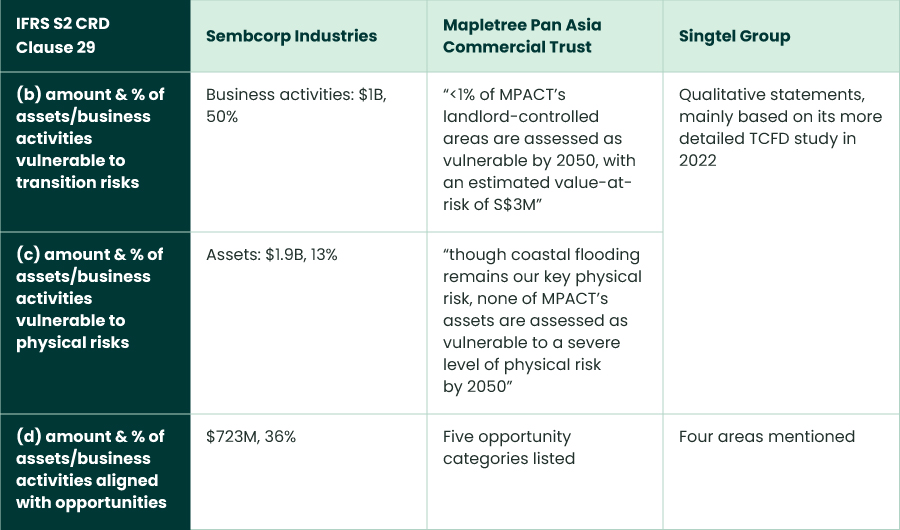
IFRS S2 categorises climate-related risks into physical risks and transition risks. Physical risks include rising sea levels, flooding, water shortages and climate migration. Transition risks arise as economies shift towards more sustainable, low-carbon models of production. These include carbon taxes, carbon disclosure requirements and the transition to renewable energy. Companies need to anticipate these shifts so that they become opportunities rather than risks.
Assessing these physical and transition risks involves modelling a series of possible scenarios to determine how these climate-related events will affect a company’s operations in the short, medium and long term. Results of the assessment then inform the company’s strategy and risk management.
Scenario analysis is one of the more challenging aspects of IFRS S2. It is not a straightforward exercise because of the uncertainties, limitations and vast amount of information involved. It remains a relatively new corporate practice that is still evolving.
ISSB recognises that companies may not have the skills, capabilities or resources to carry out risk and financial modelling, so commensurate approaches are allowed. However, companies are expected to work on improving their rigour, with the ultimate aim of providing decision-useful, quantified information for investors.
Scenarios describe an outcome at a certain time horizon and a pathway from today to the selected outcome, which can be a temperature target above pre-industrial levels. Scenario pathways refer to the political, technological and economic developments and associated risk drivers that lead to a particular scenario outcome; there can be distinctively different pathways leading to the same outcome.
Some of the more commonly used scenarios include those from the Network for Greening the Financial System (NGFS), International Energy Agency (IEA), and Intergovernmental Panel on Climate Change (IPCC). Details are available online but in summary:
There are free and commercial tools and datasets. For example, NGFS has a free scenario explorer. Country-level data might also be available, providing more granularity. Singapore has its Long-Term Low-Emissions Development Strategy and Singapore’s Third National Climate Change Study. A brief review of the choice of scenarios by Singtel Group, Mapletree Pan Asia Commercial Trust and Sembcorp Industries helps to illustrate this. A comparison among comparables from the same industry could be even more illuminating.
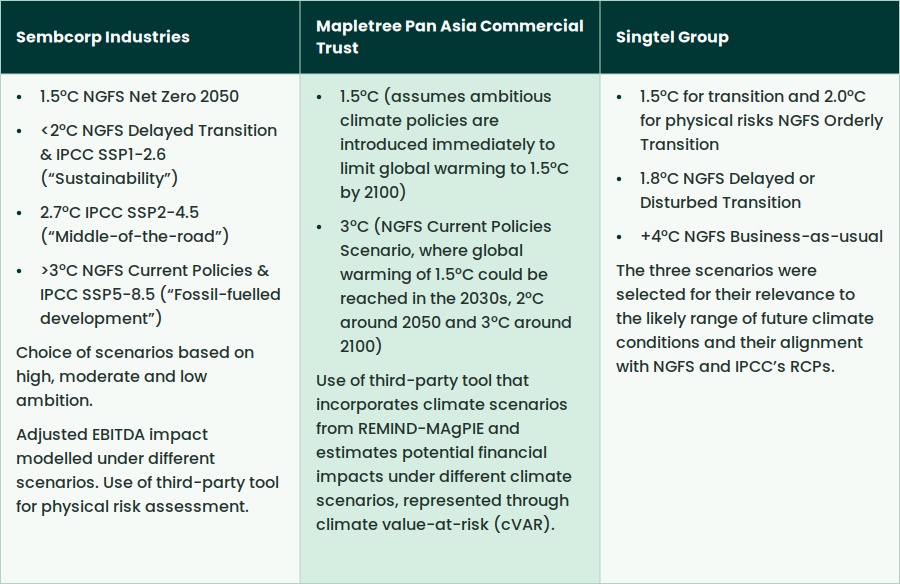
Typically, companies choose two to four scenarios covering a range of outcomes for the transition and physical risks that they face. The key principle is that the number of scenarios cover variances sufficiently great to capture the key impacts and uncertainties of the drivers a company has identified over the short-, medium- and long-term time horizons.
Part 2 of this article will cover the financial impact quantification in more detail.
Ngiam Shing Shian is Senior Sustainability Consultant, Aeterni.eco.