
As Singapore’s capital market ecosystem moves toward revitalisation, the role of corporate governance comes into greater focus. This is an area of opportunity for accountants to add more value to their organisations. As the gatekeepers of governance and financial reporting, accountants play an essential role in how companies fulfil their corporate governance obligations and policies. They are also charged with disclosing relevant information to shareholders and stakeholders.
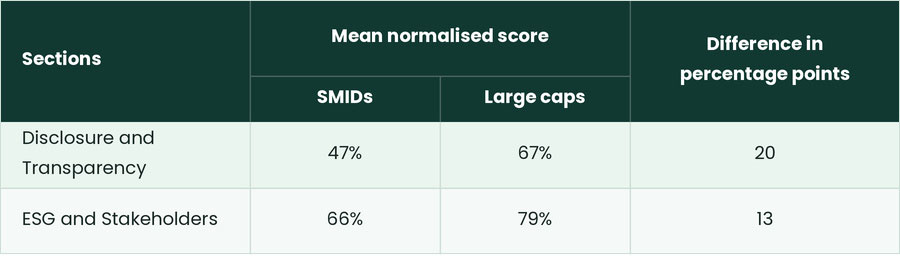
Among the listed companies in Singapore, more attention is being dedicated to good disclosures, particularly among small and mid-cap companies1 (SMIDs). The latest Singapore Governance and Transparency Index (SGTI), released in August 2026, reflects a narrowing corporate governance and transparency performance gap between SMIDs and large-cap companies. The difference in overall mean scores between SMID and large-cap companies decreased to 17.7 points in 2026, from 19.8 points in 2025. However, larger gaps remained for Disclosure and Transparency, as well as ESG and Stakeholders.
SGTI is an annual study that ranks Singapore Exchange (SGX)-listed companies on their corporate governance disclosures and practices, as well as the timeliness, accessibility and transparency of their financial disclosures.
The overall scoring system of SGTI is anchored on a five-pronged “BREAD” evaluation framework which assesses:
The scorecard comprises three key components, namely, base scores, bonuses and penalties. During the analysis of companies’ annual reports, bonus points are awarded for exemplary corporate disclosures, while penalty points are applied on a company-specific, event-triggered basis.
In the General Category, despite the narrowed overall gap between SMIDs and large caps, the latter continued to outperform SMIDs across key disclosure areas in 2026. The largest gaps were observed in Disclosure and Transparency, as well as ESG and Stakeholders.
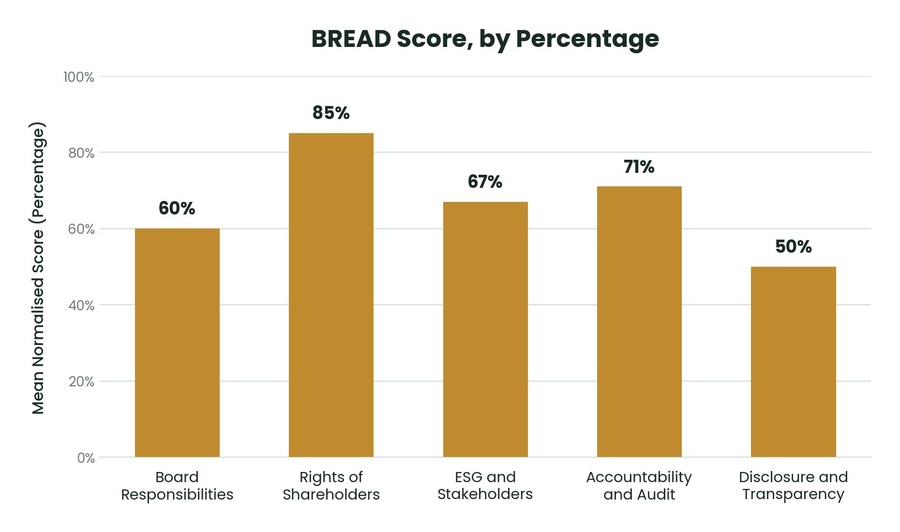
This year, companies performed strongest in disclosures related to Rights of Shareholders, achieving a mean normalised score of 85%. This was followed by Accountability and Audit, and ESG and Stakeholders, with mean normalised scores of 71% and 67% respectively.
According to Yeoh Oon Jin, Chair of SID, “Clear communication and transparency are key to helping companies unlock their true value. Companies must continue to strengthen their governance and disclosure processes so that investors can better understand their performance, prospects and long-term value.”
Financial professionals play an important role in helping their organisations identify, manage and mitigate risks while ensuring strong corporate governance to drive business sustainability, stakeholder confidence and competitiveness. For listed companies in particular, the skills to navigate the regulatory environment is non-negotiable, and this includes familiarity with the requirements in the Code of Corporate Governance.
To enhance members’ skills in corporate governance, ISCA offers short courses as well as longer programmes like ISCA Professional Business Accountant, where corporate governance is a module.
1 SMID companies have market capitalisation of up to S$1 billion. Large-cap companies have market capitalisation above S$1 billion.