Singapore has revised its full-year GDP growth forecast to 4.5 to 5.5%, up from the earlier 2.0 to 4.0%. The announcement, made in August, reflects the better-than-expected performance of the Singapore economy in the first half of the year (6.1% growth year-on-year), as well as an improved outlook for the rest of the year due to the acceleration in global artificial intelligence (AI)-related capital expenditure.
From April to June (Q2) 2026, the Singapore economy grew by 5.9% year-on-year, easing from the first quarter’s (Q1) 6.3% expansion. On a quarter-on-quarter seasonally adjusted basis, the economy grew 1.4%, extending the 1.2% growth in Q1.
GDP and Sectoral Growth Rates in 2Q 2026
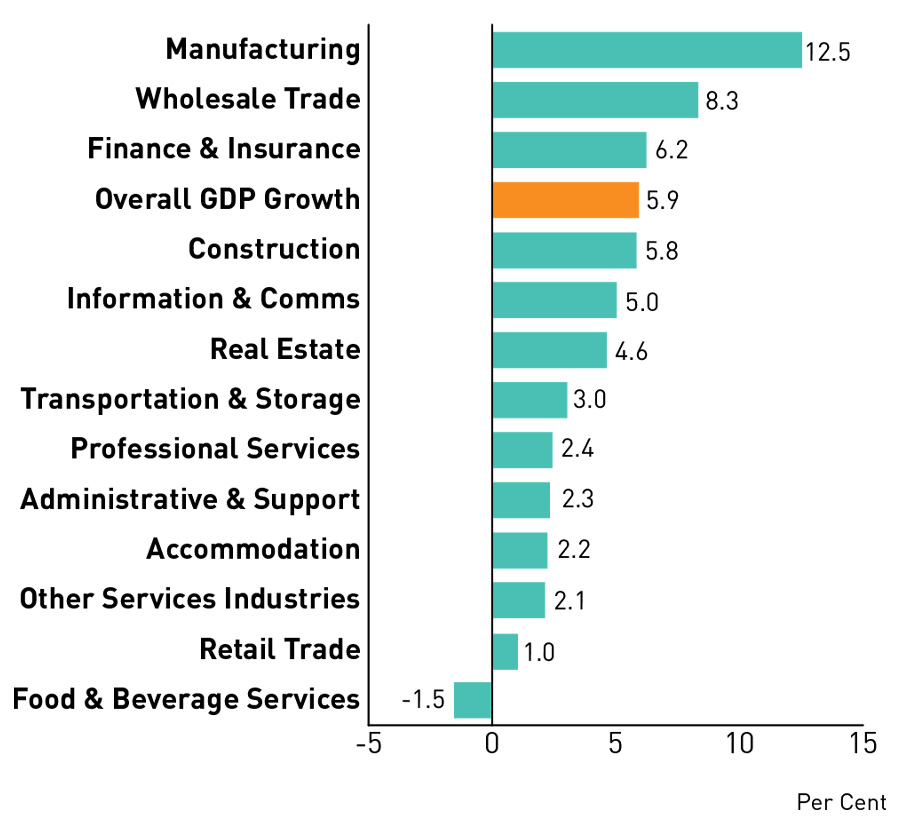
On a year-on-year basis, Q2 GDP growth was driven by the strong performance of the manufacturing, wholesale trade, and finance and insurance sectors. In particular, robust global AI-related demand boosted growth in the electronics and precision engineering clusters of the manufacturing sector, as well as the machinery, equipment and supplies segment of the wholesale trade sector.
Meanwhile, growth in the finance and insurance sector was driven by the banking segment on the back of strong credit growth and fee-generating activities. By contrast, the food and beverage services sector contracted, partly due to a sustained increase in outbound travel by locals, and a decline in visitor arrivals during the quarter.
For the rest of the year, a further acceleration in AI-related capital expenditure is expected to lift the growth prospects of economies plugged into the global technology value chain.
As Singapore is plugged into the global business world, changes in other geographies will have an impact on the country’s growth. The continuing tensions in the Middle East and blockade of the Strait of Hormuz will affect global supplies of energy and other key intermediate inputs, and exert pressure on both quantities and prices. Elevated prices will push up global inflation and weigh on global economic activity. US tariffs will also affect the exports of affected economies.
On balance, taking into account these developments and the GDP performance of the various economies in Q2, Singapore’s external demand outlook for the year has improved compared to the assessment in May (when GDP forecast was between 2.0 and 4.0%).
In Asia, China’s 2026 economic outlook is projected to expand at a slower pace in the second half of the year due to moderating export growth and subdued domestic consumption. On the other hand, like Singapore, Taiwan and South Korea are projected to benefit from the stronger-than-expected AI investment boom, which will continue to boost their exports. Similarly, growth forecasts for most of the key Southeast Asian economies are optimistic due to the expected strong growth in their AI-related exports. However, growth could moderate in the second half of the year, compared to the first half, due to weaker consumer demand amid elevated inflationary pressures.
Downside risks in the global economy remain, and any development will impact Singapore’s GDP growth figures. The risks include: