
TAKEAWAYS
Earlier this year, discussions on university course preferences suggest that students increasingly gravitate towards disciplines such as computing and data science. This has led to a growing narrative that accountancy is in decline.
A closer look at employment outcomes, career pathways and evolving industry demand tells a different story. What we are seeing is not a loss of relevance, but a gap between how the profession is perceived and what it has become.
If the accountancy profession were losing relevance, the labour market would reflect it. But, it does not. The findings from the latest Graduate Employment Survey, released by the Ministry of Education on 5 March 2026, show that accountancy graduates across Singapore’s autonomous universities continue to post high employment rates and competitive starting salaries. Employment rates consistently exceed 93% across institutions, with median starting salaries ranging between S$4,350 and S$4,680.
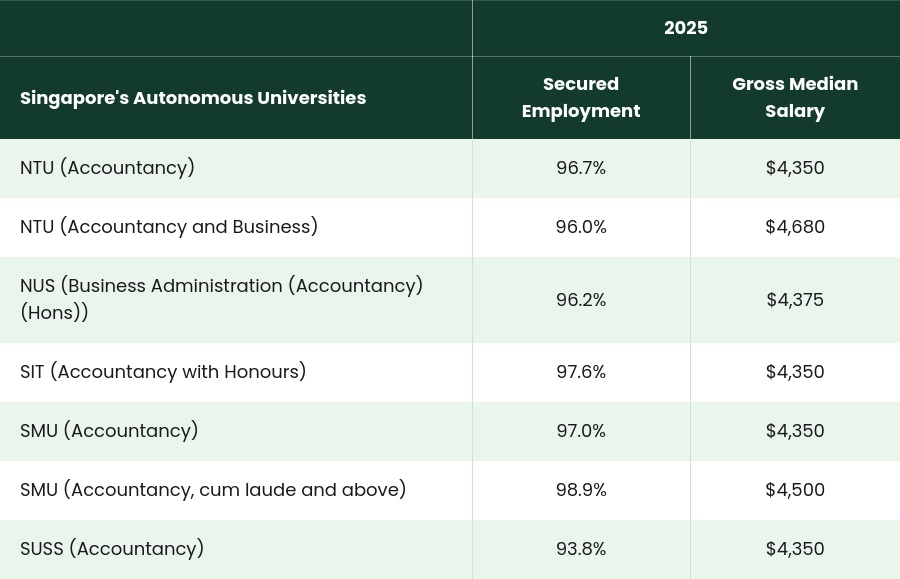
These are not the indicators of a profession in retreat, but of one that continues to deliver value to both graduates and employers.
Importantly, outcomes have remained resilient even amid broader labour market shifts. This reflects continued confidence from employers in the value of an accountancy skillset.
Enrolment trends, often cited as evidence of declining interest, also warrant closer scrutiny. While there was a noticeable dip around 2022, recent trends suggest that the decline has moderated.
At some institutions, enrolment has stabilised or even increased. At Singapore Management University (SMU)1, enrolment numbers have remained stable with a modest upward trend in 2025, and enrolment has been consistently maintained at over 250 students annually in the last three years. At Singapore Institute of Technology (SIT)2, cohort sizes have grown steadily, reaching 186 students in 2025, alongside a 33% increase in applications since 2022 to reach a record 1,209 in 2025.
These numbers point not to a structural decline in interest but to a recalibration, as students respond to a broader range of emerging career options.
As Professor Zhang Liandong, Dean of SMU’s School of Accountancy, observed, “The narrative that interest in accountancy is declining misses a larger shift taking place in the profession. Accountancy is not becoming less relevant; it is becoming more strategic as automation and AI take over routine tasks and elevate the role of accountants in guiding business decisions.”
Part of the issue lies in how accountancy is perceived. It is still often seen as a narrow pathway into audit or compliance roles. In reality, an accountancy education provides a broad foundation across finance, governance, risk, ethics and increasingly, data and digital capabilities.
Graduates today are entering a wide range of roles, from consulting and finance to business and advisory functions. Many business leaders began their careers in accountancy because it offers a deep understanding of how organisations operate, create value and manage risk.
Associate Professor Angie Low, Associate Dean (Undergraduate Education) at NTU’s Nanyang Business School, said, “While shifts in enrolment are influenced by factors such as the evolving job market, the career value of accountancy remains clear. Our graduates are not only entering traditional roles in audit and tax, but are increasingly in demand across consulting, finance, and business functions. This reflects the versatility of an accountancy education and its strong relevance in today’s evolving business landscape.”
At the same time, the profession itself is evolving.
Artificial intelligence and automation are reducing routine work, while increasing the importance of higher-value roles. Accountants are moving beyond transaction processing into areas such as data analytics, business advisory, sustainability reporting and digital transformation.
As expectations around transparency, governance and non-financial disclosures grow, so too does the need for professionals who can ensure the integrity of information.
The conversation on enrolment trends is therefore not just about numbers; it reflects how the profession is being understood by the next generation.
The data suggests that accountancy remains a discipline with strong employment outcomes, broad career mobility and growing relevance. The challenge is that this reality is not always clearly communicated.
The question, then, is not whether accountancy remains relevant – the evidence confirms it is. The real issue is whether there is a gap between perception and reality.
Closing that gap matters. In a rapidly changing economy, students are not just choosing courses, they are choosing how they will build careers, create impact and contribute to society.
Accountancy, far from being a legacy discipline, is a professional foundation that continues to evolve with the needs of a changing economy. The task ahead is to ensure that this reality is understood as clearly as the data already shows.
1 Information provided by SMU
2 Information provided by SIT