

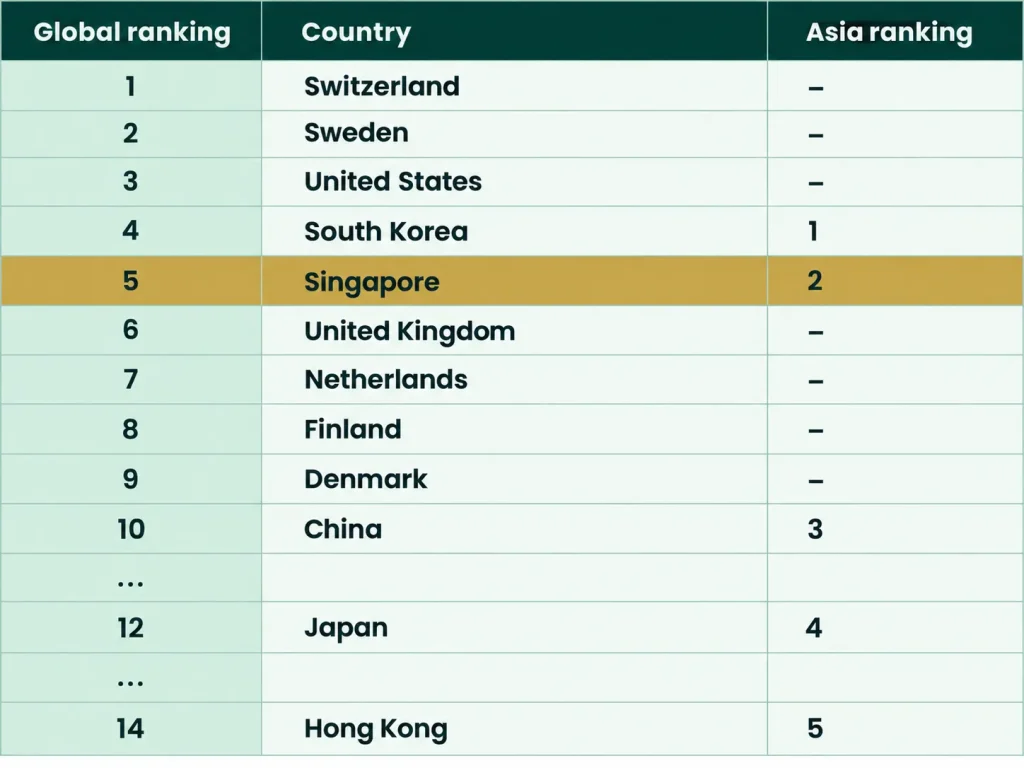
Singapore’s position as an innovation hub is gaining further international recognition. The Global Innovation Index (GII) 2026, published by the World Intellectual Property Organization (WIPO) in September, ranks Singapore fifth among 139 economies worldwide; it stands behind, respectively, Switzerland, Sweden, United States and South Korea. Significantly, in this year’s GII, Singapore ranks first globally for innovation inputs, and ninth in outputs.
GII 2026 Ranking: Global and Asia
Measured against the size of the economy, the leaders look different, with smaller nations taking the top two places. On the GII indicator of unicorn valuation as a percentage of GDP, Estonia ranks first (19%), followed by Singapore (18%); and the US, third (13%).
The ranking reflects the infrastructure Singapore has built around research, technology, talent and business. But, the GII data also points to an important distinction: Singapore ranks ninth for innovation outputs. Given Singapore’s global first place for innovation inputs, this gap suggests that converting strong innovation capabilities and investment into commercially successful and other tangible outputs should be a priority area in Singapore’s innovation journey.
Singapore has been strengthening its innovation ecosystem over the years. To date, it is home to more than 70 AI centres of excellence, including for well-known names like Anthropic, Google DeepMind, Microsoft, Nvidia, and OpenAI. They add to the city-state’s S$1-billion, five-year national plan (slated to last till 2030) to boost AI research, and form part of the National AI Strategy 2.0 to position Singapore as a global hub where real-world uses of AI are showcased.
Singapore is also the R&D base for multinational companies such as Bosch and Coca-Cola, which are using the city-state as a platform for innovation and research. This reflects the country’s role beyond simply being a regional headquarters location.
Another measure of the ecosystem is IP. In August, the National Research Foundation reported that Singapore’s public research institutions had filed around 8,000 patents under the Research, Innovation and Enterprise (RIE) plans over the previous decade. Around 20% had been commercialised through licensing or assignment, with commercialisation typically taking two to four years – a time lapse that could be shortened.
Separately, universities and research institutes are also working to narrow the time it takes for research to become economically viable. For example, in September, NUSX (formerly NUS Enterprise) announced its evolution into an integrated venture-building and IP commercialisation platform. Its newly launched Nova is an AI platform designed to analyse patents, assess licensing opportunities and identify potential commercial partners.
Singapore’s innovation model also depends on creating environments where technologies can be tested. The LaunchPad Innovation Network (LINK) has expanded its mandate to create more opportunities for LaunchPad startups to pilot solutions and accelerate market adoption. LaunchPad @ One-North brings together startups, incubators, accelerators and venture capital firms. To be launched in phases from late 2026, LaunchPad @ Punggol Digital District is purpose-built for companies in the areas of fintech, robotics, and cybersecurity to testbed their innovations.
Nationally, Singapore is connecting research, IP, capital, talent, multinational companies, startups and real-world testbeds. These developments show that the country is serious about securing its position as an innovation hub of repute, providing support for startups to progress from ideation all the way to commercialisation.
Related articles on CA Lab:
