


TAKEAWAYS
“Would we sign off on our greenhouse gas emissions numbers the way we sign off on our financial results?” Increasingly, boards must answer this question about sustainability reporting.
For years, success meant publishing an ESG (environmental, social, governance) report that supplemented the annual report. Today, there is a quiet shift in expectations for companies to provide assured, financially relevant climate-related information that can withstand external scrutiny. In other words, ESG and financial disclosures must be equally reliable.
That raises a question every board should be able to answer and that is, “If an investor, lender or regulator challenged our climate numbers tomorrow, could we stand behind them?”
Singapore has consistently responded to evolving sustainability reporting expectations with a deliberate and phased approach: first strengthening governance, reporting capability and consistency; then expanding climate-related disclosures; and eventually introducing assurance requirements. The timeline extension announced by ACRA and SGX RegCo in August 2025, and subsequently refined in July 2026, gives companies more time to build the systems and skills required for the transition.
The regulatory landscape continues to evolve. In July 2026, ACRA launched a public consultation on the Singapore Sustainability Disclosure Standards, proposing that climate-relevant portions of SFRS S1 be incorporated as an appendix to SFRS S2, enabling SFRS S2 to operate as a standalone standard covering all climate-related disclosure requirements. Under the proposal, SFRS S2 would remain the mandatory climate disclosure standard, while broader sustainability-related financial information disclosures addressed by SFRS S1 would continue to be voluntary.
Figure 1 Singapore’s sustainability reporting journey
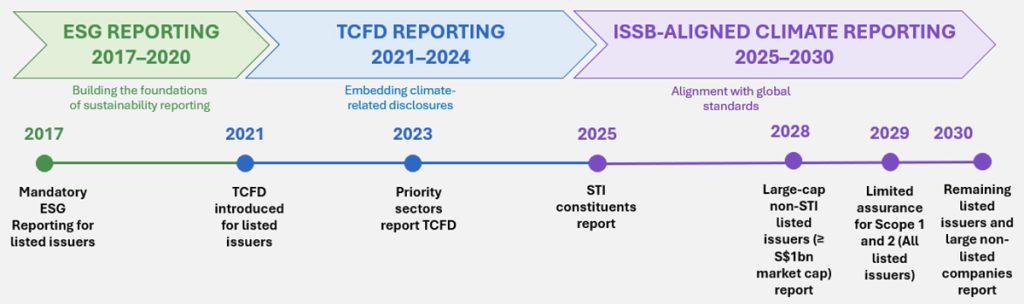
That extra time is useful, but it can also turn “more time” into “less urgency”. Regulatory deadlines have moved, but the expectations of investors, lenders, customers and supply-chain partners have not.
As frameworks mature, attention is shifting from compliance to business and financial consequences. Many stakeholders are still navigating the evolving ESG landscape and determining how best to orientate themselves to the changing pace and demands of ESG adoption.
Climate risks increasingly interact with geopolitical, operational and technological pressures.
Together, these pressures make climate risk a financial consideration. Companies may need to invest in resilience, energy efficiency and low-carbon technologies to protect operations and adapt to changing markets. To choose and prioritise those responses, companies need consistent, credible information, bringing data governance and assurance to the forefront.
Climate disclosures are most decision-useful when the underlying data is credible. Companies should consistently measure uncertainty, explain key judgements and apply estimates, organisational boundaries, methodologies and base years on a comparable basis.
Companies need not wait for mandatory assurance to discover where their data falls short. An assurance-readiness exercise – a dry run of what an external provider would test – can identify gaps in sustainability data management, reporting processes and assurance preconditions. Built into the annual reporting cycle, it turns assurance from a rectification project into one that gives companies peace of mind.
A credible climate strategy is also visible in decisions, not just commitments. Reflecting key themes highlighted within IFRS S2, these areas often provide useful indicators of whether climate considerations are being embedded into business and financial decision-making:
Climate disclosures are no longer treated as marketing information. They increasingly provide insights into whether a company is positioned for long-term resilience or faces more immediate climate-related challenges. The implications to readers who do not know how to interpret such information can be costly.
Here are three questions any director can take to the next board meeting:
For many boards, the honest answer to the title question is, “Not yet, but soon.” That is not unusual; the rules have deliberately allowed time for preparations. But the value lies in using it. Boards that apply the same rigour to climate assumptions as they do to financial forecasts will not scramble when assurance arrives. They will already have earned the confidence of lenders and investors.
Victoria Lim is Senior Consultant, RSM ESG Advisory.
