

TAKEAWAYS
Volunteers are the backbone of non-profit organisations (NPOs), contributing their time, energy, and skills to meaningful causes. Traditionally, NPOs have used a B2C (business-to-consumer) model of volunteer management: each organisation recruits, onboards, trains, and manages its own volunteer pool. Platforms such as Volunteer SG and Giving.sg improve visibility by consolidating opportunities from multiple NPOs, but this approach still depends on individuals taking the initiative to search and sign up.
The National Giving Study by the National Volunteer and Philanthropy Centre (NVPC) shows that resident volunteer participation has remained between 21% and 30%, while median volunteer hours have declined over the past decade. With Singapore’s rapidly ageing population and rising demand for community support services, NPOs may need new ways to strengthen and sustain volunteer participation.
Although B2C approaches can expand the volunteer base, their impact is limited because NPOs compete for the same finite pool. The challenge, therefore, is not only to attract more volunteers but also to use existing capacity more effectively. What if organisations complemented their own recruitment efforts by collaborating to deploy available volunteers more efficiently?
We propose complementing the current B2C approach with a B2B model. Alongside recruiting through their own channels, NPOs could partner with one another to share volunteer resources and capabilities through a common ecosystem.
Participating NPOs would contribute to and draw from a shared volunteer pool, extending volunteer management beyond organisational boundaries and using capacity across the wider sector. This would give organisations access to broader networks and enable volunteers to be deployed more efficiently in response to community needs.
However, a B2B model also presents several challenges.
1. Reluctance to collaborate with competitors
NPOs may hesitate to work together because they compete for volunteers, donations, and grants. Some may therefore resist sharing volunteer networks for fear of losing volunteers.
2. Concerns about unequal contributions and benefits
Differences in resources and organisational capacity may lead to unequal contributions, influence, or returns, potentially weakening the partnership.
3. Greater complexity
A shared volunteer ecosystem requires more communication, coordination, and joint decision-making. For resource-constrained NPOs, the perceived administrative burden may outweigh the immediate benefits.
The most difficult challenge may be changing the perception that other NPOs are competitors. In a resource-constrained environment, organisations often compete for volunteers, funding, and public attention, so hesitation to collaborate is understandable.
Yet, collaboration and competition are not mutually exclusive. Organisations can practise “coopetition” by working together in selected areas while retaining their distinct identities, programmes, and goals. Rather than competing for a larger share of the same pie, they can jointly expand it and create value for all. The key question is not whether to compete or collaborate, but how to collaborate effectively while preserving individual strengths.

Successful partnerships require deliberate effort: building trust, aligning expectations, and establishing mechanisms to manage the relationship over time. The Co-Alignment, Co-Action, and Co-Growth framework offers a practical pathway:
Co-Alignment, Co-Action, and Co-Growth for B2B partnerships between NPOs
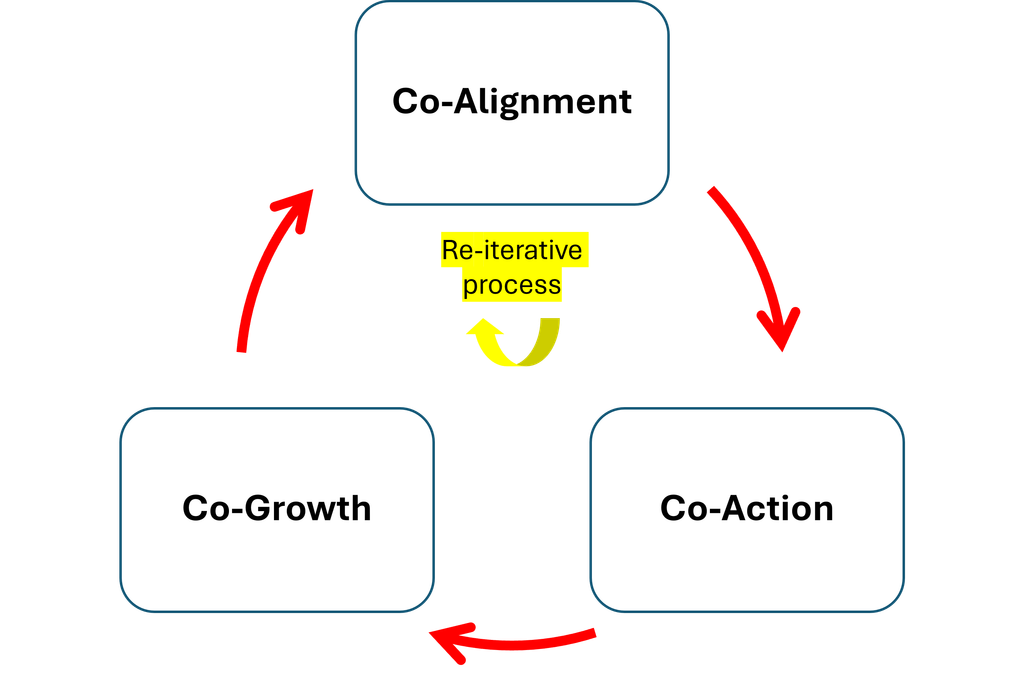
1. Co-Alignment (“We dream together”)
The first step is identifying the right partners and aligning around a shared purpose. Successful partnerships begin with a clear understanding of community needs, partner contributions, and desired outcomes.
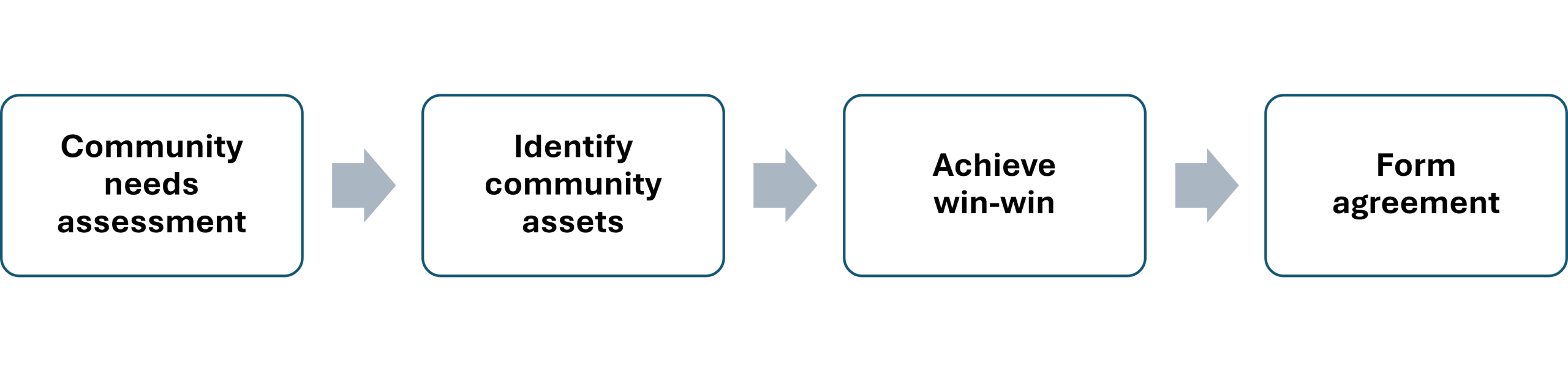
Community needs assessment
Start by conducting a community needs assessment to identify areas where additional volunteer support is required. This involves understanding community needs and service gaps. Needs that cannot be addressed with internal resources alone may signal opportunities for collaboration. The findings should be used to determine the focus of the collaboration.
Identify community assets
Next, identify potential partners through community asset mapping. Consider organisations within and beyond your neighbourhood, and assess the resources, volunteer networks, expertise, and programmes where they can contribute. Prioritise partners with similar values, priorities and organisational identity, but be mindful of excessive overlap in capabilities or services, as this may increase competitive tensions.
Achieve win-win
Engage potential partners to explore shared goals, common challenges, and collaboration opportunities. Discuss each organisation’s capabilities and potential contributions, and explore the mutual value that can be created through working together. As discussion may become challenging if the parties perceive their interests to be competing or conflicting, it is essential to adopt a win-win mindset. Focus on underlying interests rather than positions, and identify solutions that address the needs of all parties.
Partners should also agree on the boundaries of the collaboration and areas where they will continue to operate independently. Starting with a small pilot initiative, such as jointly recruiting volunteers for a community event, can help build trust and test the partnership before scaling up.
Form agreement
Finally, formalise the collaboration through a written agreement, such as a Memorandum of Understanding (MOU). The agreement should outline the scope of collaboration, partner obligations and resource commitments. Formal agreements provide clarity, minimise potential for opportunistic behaviour, and create a foundation for effective collaboration.
2. Co-Action (“We do together”)
Once common goals have been established, partners must translate them into action. As NPOs balance both collaborative and competitive relationships, tensions may arise during implementation. The Co-Action stage focuses on coordinating efforts while managing these coopetitive dynamics.
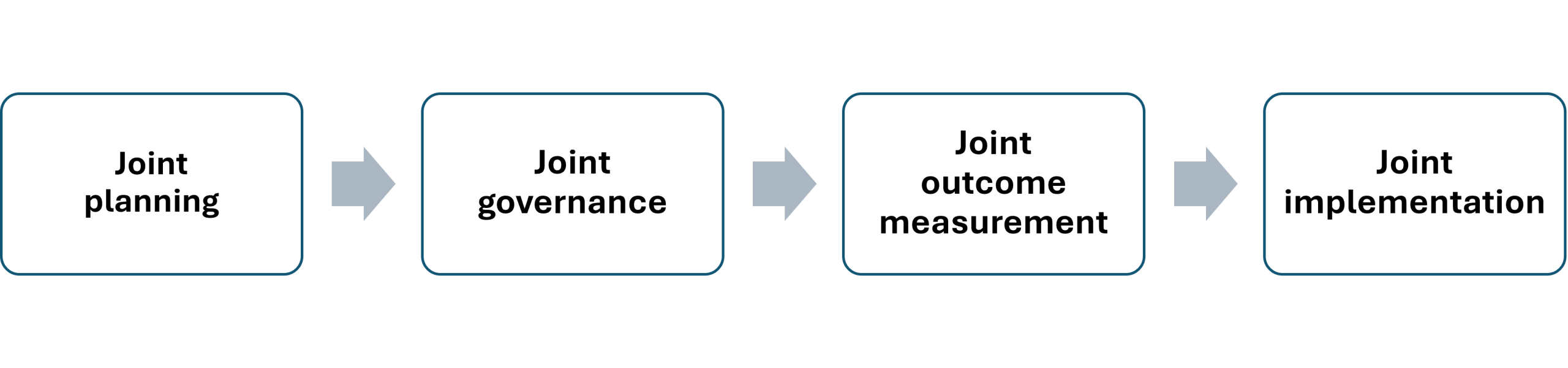
Joint planning
Develop a joint action plan that outlines key activities, timelines, responsibilities and resource commitments. Tools such as Gantt Charts, shared calendars and RACI matrices can be used to track progress and clarify accountability.
Joint governance
Establish governance arrangements to guide how the collaboration will be managed. This includes defining decision-making authority, reporting lines, communication channels, and dispute resolution processes. Where organisations differ significantly in size or resources, special attention should be paid to balancing decision-making influence and workload distribution.
Joint outcome measurement
Establish measurable outcomes to assess the success of the collaboration. KPIs should align with the collaboration’s objectives and be supported by clear data collection methods (example, surveys, interviews, programme records). Frameworks such as SMART goals can help partners develop specific and measurable indicators.
Joint implementation
Execute the agreed action plan and coordinate activities through regular project meetings. As organisations move from planning to implementation, they must continue to balance cooperative and competitive relationships. Clear escalation procedures, designated points of contact, and regular review meetings can help resolve disagreements over decision-making, workload, resource allocation, and changing priorities. It is important to pay close attention to conflict management strategies to prevent conflicts from undermining the partnership.
3. Co-Growth (“We grow together”)
Sustaining a partnership requires ongoing investment in both relationships and processes. The Co-Growth stage focuses on building trust to maintain and strengthen the collaborative relationship.
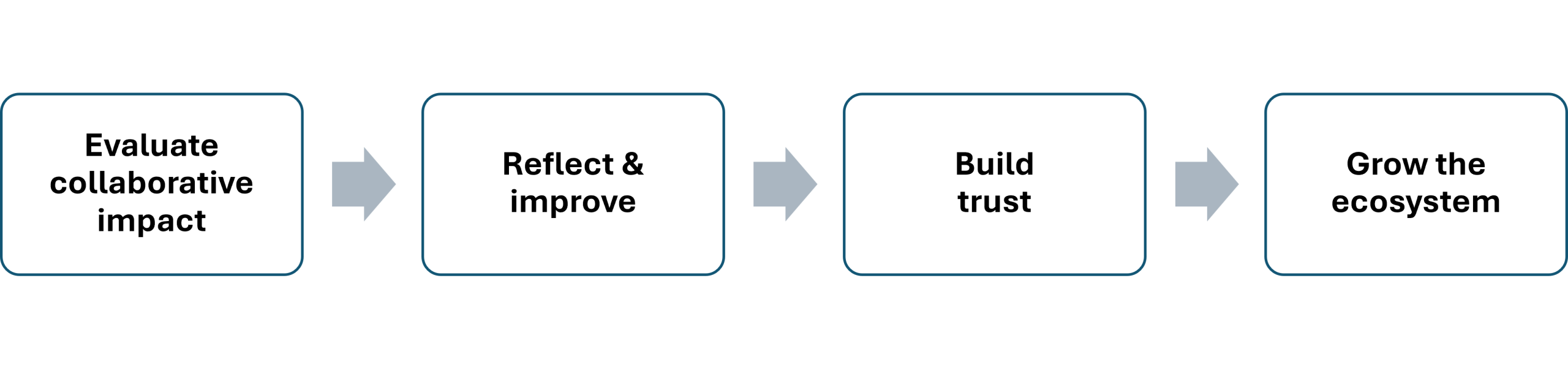
Evaluate collaborative impact
Regularly review the shared goals and KPIs established earlier to assess whether the collaboration is creating the intended value. Partners should also evaluate whether benefits are distributed fairly, and continue to meet the needs of all organisations involved.
Perceptions of reciprocal benefit strengthen trust and commitment to the partnership, while perceptions of unequal benefit can increase coopetitive tensions and opportunistic behaviour. Where necessary, targets, resource allocations or implementation plans should be adjusted to maintain mutual value.
Reflect & improve
At key milestones, partners should reflect on the collaboration by asking:
Document both the lessons learnt and successful practices that can be applied to future collaborations. Regular reflection helps surface concerns early, strengthens trust, and improves how partners work together.
Build trust
While formal agreements help manage risks in the early stages, long-term trust is developed through repeated positive interactions and reinforcement of social and reputational bonds. NPOs can strengthen trust by honouring commitments and delivering on agreed responsibilities. As confidence grows, organisations become more willing to share resources, exchange knowledge, and collaborate on larger initiatives.
Grow the ecosystem
As trust deepens, collaborations can expand beyond individual projects into a broader network of partners. NPOs can strengthen the volunteer ecosystem by deepening existing relationships, bringing in new collaborators from various sectors, and sharing not only volunteers, but also knowledge, capabilities, networks, and other resources. As more organisations contribute to and benefit from the ecosystem, collective capacity grows and the sector becomes more resilient, connected, and impactful.
The following three principles can help organisations put these steps into practice and build successful collaborations.
1) Co-Alignment: Finding common ground – Focus on the same-same and not different-different
Although NPOs may initially see one another as competitors, collaboration becomes possible when they focus on shared challenges and opportunities, such as expanding volunteer capacity, meeting growing community needs, or improving volunteer engagement. Emphasising common ground helps organisations reduce competitive concerns, build trust, and establish a strong foundation for partnership.
2) Co-Action: Focus on what you do best, outsource the rest
Differences in priorities, operating styles, and resources will inevitably emerge. A strengths-based approach can reduce friction: partners identify their distinctive capabilities and allocate responsibilities accordingly. Tapping on complementary strengths limits duplication, clarifies decisions, and allows each organisation to contribute where it creates the greatest value.
3) Co-Growth: Invest in relationships for long-term impact
Strong working relationships can turn one-off collaborations into lasting partnerships. By consistently creating value, honouring commitments, and addressing challenges together, partners demonstrate reliability and fairness. This builds confidence, supports deeper collaboration, and strengthens the volunteer ecosystem.
As social needs evolve and volunteer resources remain limited, NPOs may need to broaden their approach to volunteer management. A shared volunteer ecosystem can expand access to volunteer networks, improve deployment, and harness complementary organisational strengths.
Achieving this vision requires a shift from competition to coopetition. NPOs can collaborate where their interests align while continuing to pursue their distinct missions. The Co-Alignment, Co-Action, and Co-Growth framework offers a practical roadmap for building trust, coordinating action, and sustaining partnerships.
The aim is not merely to expand individual volunteer pools, but to strengthen the volunteer ecosystem as a whole. By sharing volunteers, knowledge, and capabilities, organisations can create a more resilient, connected ecosystem that responds more effectively to community needs and delivers greater social impact.
Professor Ang Hak Seng is Director of Centre of Excellence for Social Good, and Professor of Social Entrepreneurship, Singapore University of Social Sciences.
Related articles by Prof Ang: