
TAKEAWAYS
Ask a room of young professionals what makes a good leader, and most will point somewhere ‘above’ them in a typical corporate hierarchy: a manager, mentor or someone with a title. But in a recent episode of CA Listen Sparkling Conversations, students from ISCA’s Global Talent Programme (GTP) turned that question inward instead.
The vodcast features four students from ISCA’s GTP 2026:
In the session hosted by Shi Yang Shawn, an undergraduate from the Shanghai University of Finance and Economics, the four ISCA #CAStars shared what leadership means to them, and what they expect from the organisations they are about to join. Their answers provide an insightful preview for employers as they represent how the next generation thinks about influence, loyalty, and leadership.
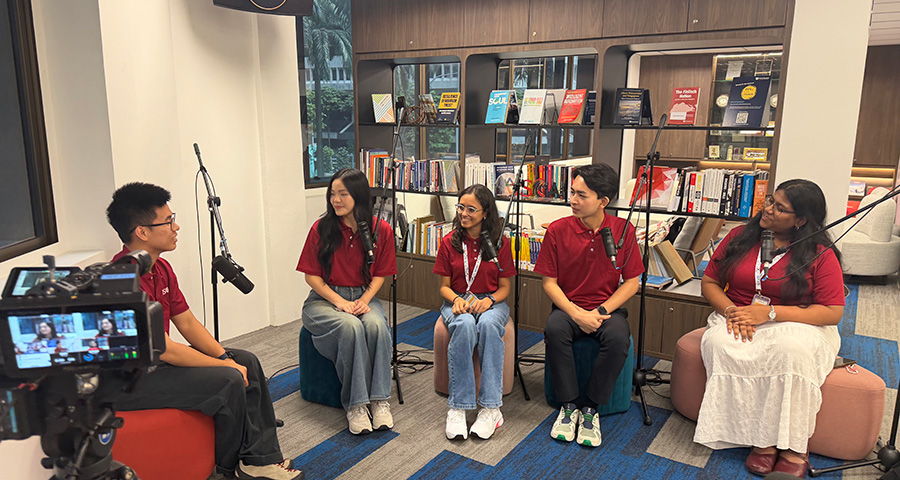
Shawn posed two questions to his peers: “What does leadership mean to you?” and “What leadership qualities do you admire the most?”
The responses converged quickly on the idea that leadership is not a position but a form of trust. Pradakshina described it as the ability to inspire and influence behaviour. She drew a distinction between a manager (someone with a ‘title’), and someone people turn to in a crisis, whether or not one is officially in charge.
The theme of humility ran through the conversation. Krit and Dhyana shared that the leaders they admire most are humble and open-minded; they make people feel involved enough to want to contribute, rather than simply comply. Shawn summarised the discussion with a memorable image and that is, a good leader operates like a lighthouse, showing the way rather than steering the ship for everyone.
If leadership isn’t a title, the ISCA #CAStars argued, it also isn’t something that one waits to start developing only when one starts work. Zhi Ying traced potential possible leadership opportunities and roles though university clubs, societies and group projects. The environments are low-stakes enough to fail in, but real enough to teach. Pradakshina offered a correction to the common myth of the ‘born leader’. Leadership, she said, is cultivated continuously through different roles and experiences; it is not switched on the moment someone accepts a title.
Dhyana shared her observation that leadership is practised from being a member of a club or society, and understanding the problems members face. Once that first-hand perspective is earned, one can then step up into a leadership role.
Underscoring the discussion was the importance of foundational soft skills, such as teamwork, communication and listening. As Pradakshina noted, a football team doesn’t function if only one player is trying to score every goal. Being a dependable teammate has to come before being a dependable leader, a point reinforced by Krit’s account of the tough calls involved in staffing a real project team.
When they were asked what employers most often overlook, Krit pointed to mentorship, with direct access to the guidance of more experienced professionals. Pradakshina added that in today’s fast-changing, volatile work environment, mentorship and learning agility matter more than ever.
For Dhyana, what was missing was trust. Employers often do not believe that young employees are ready for real responsibility. Being handed a meaningful project early in their career matters more than a high salary and other perks.
Something less tangible but just as important is giving employees the time and space to speak up. Zhi Ying opined that new graduates can bring fresh perspectives, though not all employers are receptive. Oftentimes, young employees are told that “this is how things have always been done”.
Turning to retention and what would make a young professional stay with an organisation for five years or more, the students’ answers were almost unanimous: a sense of purpose. This is not a mission statement on a wall, but a genuine feeling that the work matters, paired with personal goals that align with the organisation’s.
While some pushed back on the idea that titles and pay packages are the primary draw, one ISCA #CAStar observed that their generation is quietly moving away from chasing ‘fancy titles’ toward a simpler question, “Does this work make me a better version of myself?” Recognition still matters to young employees, but there is no need for big gestures. A small, specific acknowledgement from a manager can make the long hours and workers feel seen, rather than invisible.
The final and liveliest exchange centred around how leadership should adapt to remote and hybrid work. Leaders now have to communicate and build trust deliberately, make sure every team member feels involved rather than rely on it happening naturally, and stay connected even when not everyone shares a physical office.
The students agreed that hybrid arrangements push leadership to become more output-focused, simply because it is harder to observe soft skills like empathy or collaboration through a screen. Pradakshina offered a sharper counterpoint: if genuine connection is harder to build remotely, then leaders who can still manage it stand out even more. This means soft skills may matter more in a hybrid world, not less.
By the close of the conversation, it was established that leadership starts with self-awareness, not a title, and nobody is born into it. Leadership is built gradually, through every difficult decision along the way.
As the world of work continues shifting toward remote and hybrid models, the soon-to-be professionals from GTP 2026 were clear about what separates the leaders who succeed from the rest, and that is, the ability to combine empathy with results, rather than choosing one over the other.
Look out for more stories from this year’s ISCA #CAStars in the October issue.