

TAKEAWAYS
In August 2023, Singapore authorities conducted the largest anti-money laundering (AML) operation in the country’s history, seizing approximately S$3 billion in assets. What emerged in the weeks following was troubling, but not surprising to those who understand how criminals think.
At least five of the accused had donated six-figure sums to Singapore’s most reputable charities, including President’s Challenge, Sian Chay Medical Institution, Rainbow Centre, Community Chest, and National Kidney Foundation.
More than S$800,000 in donations made by four convicted foreigners have since been surrendered to authorities.
The question we should be asking isn’t “Why didn’t the charities catch this?” Instead, it should be “Why did the criminals donate in the first place?”
“Where the charity is legitimate, it could be to lower their taxable income, to obtain goodwill and standing in the community, or even just to acquire good karma.” That’s how one lawyer explained the donations to The Straits Times, but there was likely a more calculated motive.
Reports emerged that some of the accused had tried to offer donations to clan associations in exchange for honorary titles as evidence of “community integration” that could support citizenship or permanent residency applications. This is white washing – the deliberate use of charitable giving to launder reputation, not money.
The donations weren’t acts of generosity. They were investments in legitimacy to gain social standing, community recognition, and evidence of good character to support residency applications or business credibility.
The charity becomes an unwitting accomplice not to moving illicit funds, but to “cleaning” the donor’s public image.
Singapore’s S$3-billion case isn’t unique. The 1MDB scandal had also shown white washing on a global scale.
Jho Low, the Malaysian financier at the centre of the scandal, allegedly donated over US$200 million to charities worldwide, including US$50 million to MD Anderson Cancer Center and US$25 million pledged to the United Nations Foundation.
His philanthropy bought him celebrity access, legitimacy by association, and a counter-narrative. Actor Leonardo DiCaprio personally thanked Low as a “collaborator” in his 2014 Golden Globes acceptance speech. Low was given “special thanks” in the credits of “The Wolf of Wall Street”, a film about financial fraud, funded in part by the alleged stolen money.
The charities weren’t complicit. They were exploited.
After the S$3-billion case broke, Singapore’s Commissioner of Charities issued an urgent advisory, urging all charities to review their donor records from as far back as January 2019, and file Suspicious Transaction Reports (STRs) if they found irregularities.
The charities responded swiftly but the episode exposed a painful truth. “We have multiple sources of donations and a large volume of donors, and it is difficult to do in-depth checks on each of them.” The admission, from a charity leader quoted in the media, captures the dilemma facing Singapore’s more-than 2,300 registered charities.
Most operate on lean budgets. Compliance infrastructure competes with programme delivery for limited funds. Staff are hired for their passion for the cause, not their AML expertise.
The regulatory framework, namely, CDSA, TSOFA, and COC Code of Governance, assumes capability that often doesn’t exist. The expectation gap is real – regulators expect Know Your Donor (KYD) processes, sanctions screening, and STR-filing capability. Most NPOs have basic receipt-keeping and trust-based acceptance.
White-washing donors don’t announce themselves but they leave patterns.
Donor profile red flags:
Behavioural red flags:
Transaction red flags:
Contextual red flags:
The challenge is that most of these red flags require some level of due diligence to detect – and that’s precisely what many NPOs lack.
More regulation isn’t the answer. The framework already exists.
More de-risking isn’t the answer either. When banks can’t distinguish well-governed NPOs from compromised ones, they often avoid the sector entirely, pushing charities towards less transparent channels and actually increasing vulnerability.
The answer is capability building – equipping NPOs with knowledge, tools, and governance frameworks to understand their risk exposure; implementing proportionate donor due diligence; recognising red flags, and demonstrating their integrity to banks and regulators.
This isn’t about turning charities into compliance departments, it’s about giving them the minimum viable toolkit to protect themselves.
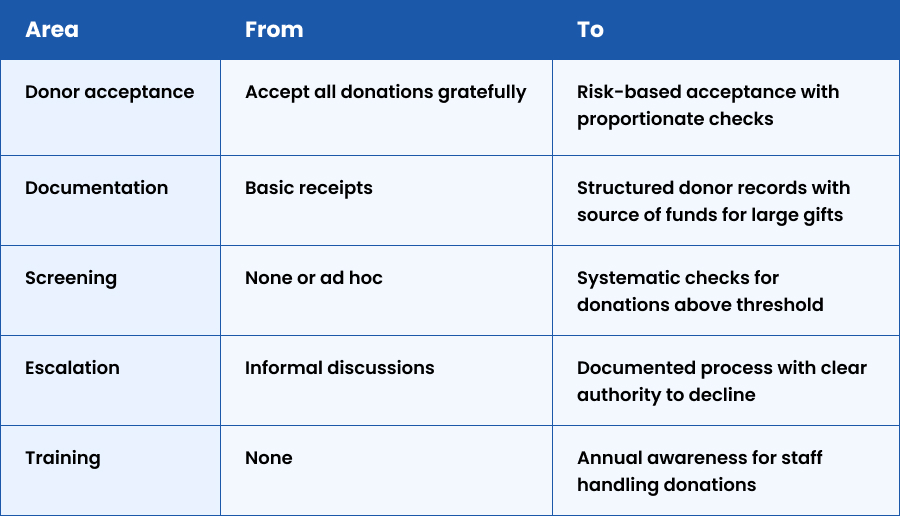
The proportionality principle matters. FATF’s February 2025 Standards update introduced a critical shift from “commensurate” to “proportionate” controls. For example, a S$50 donation from a regular supporter doesn’t need the same scrutiny as a S$100,000 donation from an unknown foreign national. Capability building helps NPOs make that distinction intelligently.
This is where finance professionals, accountants, auditors and advisors become essential. NPOs need help from those who understand risk-based frameworks, internal controls, documentation standards, and regulatory obligations.
As board members: Bring financial expertise to charity boards. Champion proportionate controls. Ensure audit committees actively review donation patterns.
As auditors: Go beyond financial statement audits to assess governance controls. Flag gaps in donor due diligence. Recommend practical improvements suited to the charity’s scale.
As advisors: Help charities develop fit-for-purpose KYD policies. Train staff on red flags and escalation procedures. Assist with STR filing when required.
The charitable sector shouldn’t have to figure this out alone. Finance professionals are uniquely positioned to bridge the capability gap.
The white-washing threat is real. Criminals donate to charities not despite their crimes, but because of them. Philanthropy buys legitimacy, community standing, and in some cases, immigration advantages.
Singapore’s charitable sector cannot afford to be naive about this reality.
But, the answer isn’t to treat every donor as a suspect. It’s not to burden lean charity teams with bank-grade compliance programmes, and it’s certainly not for banks to de-risk the sector entirely.
The answer is proportionate capability building.
Give NPOs the knowledge to understand their risks, the tools to conduct sensible due diligence, the frameworks to escalate and decline when necessary, and the confidence to demonstrate their integrity.
Finance professionals have a critical role to play. As board members, auditors, advisors, and advocates, you can help bridge the capability gap that the S$3-billion case exposed.
The charitable sector exists to serve those who need it most. Protecting its integrity isn’t just a compliance exercise, it’s how we ensure that trust remains deserved.
Part 2 of the article will look at the NPO Vulnerability Self-Assessment Checklist – a practical tool for assessing an organisation’s governance, financial controls, donor due diligence, and reporting readiness – and the actions NPOs can take, based on their vulnerability scores.
Julia Chin is Founder/CEO, JFourth Solutions.