Just 25% of Gen Zs and 21% of millennials prefer fast-paced career progression marked by rapid promotions. Most favour gradual growth, or are willing to make lateral moves to build experience that supports long-term success.
Despite financial pressures, 53% of Gen Zs and 45% of millennials expect their personal financial situation to improve within the next year.
Accelerated learning and career growth are the top cited impacts of artificial intelligence for entry-level workers.
As Gen Zs and millennials1 move deeper into adulthood and leadership, they are reshaping how progress at work is defined, often prioritising stability, skills, and well-being before advancement, according to Deloitte’s 2026 Global Gen Z and Millennial Survey. The research analyses the responses of more than 22,500 Gen Zs and millennials, alongside qualitative insights from business leaders, across 44 countries2.
“For 15 years, this survey has captured how Gen Zs and millennials respond to change, and how they shape it,” says Elizabeth Faber, Deloitte Global Chief People & Purpose Officer. “They’ve already transformed work in tangible ways and are now making deliberate choices about when, and under what conditions, they pursue leadership and major life decisions. This year’s findings show that these generations are adaptable, pragmatic, and intentional about progress, even as economic pressure and rapid technological change raise the stakes.”
Source: 2026 Global Gen Z and Millennial Survey, Deloitte Touche Tohmatsu Limited
FINANCIAL PRESSURE IS RESHAPING PERSONAL AND PROFESSIONAL TIMELINES
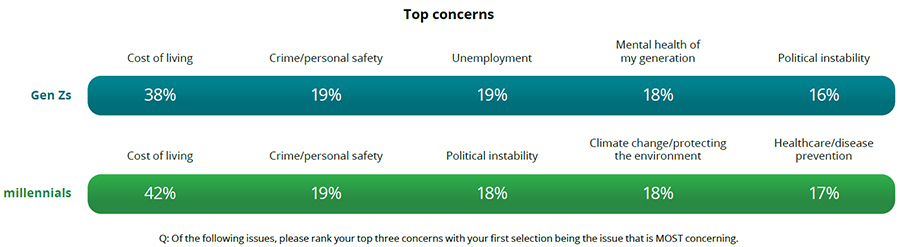
For the fifth consecutive year, cost of living is the top concern for both generations, far outpacing other societal concerns. Financial pressure is driving the “maybe later” trend for these generations: while they are ambitious, their financial reality has altered timelines for major milestones.
Financial constraints are altering timelines. More than half of Gen Zs (55%) and millennials (52%) say they have delayed major life decisions, such as starting a family, furthering education, or launching a business, due to their financial situation.
Housing affordability remains a significant constraint and influences career decisions. Some 69% of Gen Z and 64% of millennials say that the availability or affordability of housing has a direct impact on their career decisions and where they can work.
Despite these pressures, financial optimism persists. About 53% of Gen Zs and 45% of millennials expect their personal financial situation to improve within the next year.
LEADERSHIP REMAINS ATTRACTIVE, BUT ONLY IF IT’S SUSTAINABLE
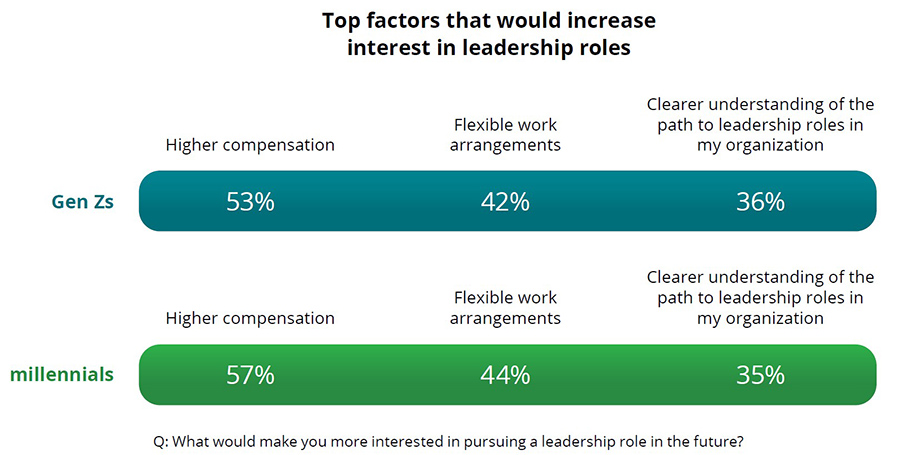
Interest in leadership is widespread, but not urgent. Consistent with last year’s findings, only 6% of Gen Zs and millennials say achieving a leadership position is their primary career goal. The hesitation is driven by concerns about the tradeoffs that being in a leadership role may present.
Gen Zs and millennials are making career choices that prioritise long-term fit over short-term advancement. Most Gen Zs and millennials favour steady progress (44% of Gen Zs; 45% of millennials) over rapid promotions (25% of Gen Zs; 21% of millennials), with some even willing to move laterally or take a step back to find the right role (21% of Gen Zs; 20% of millennials).
Leadership is associated with well-being tradeoffs. The most commonly cited barriers to leadership are stress and burnout (50% of Gen Zs; 49% of millennials), excessive responsibility (50% of Gen Zs; 48% of millennials), and concerns about work-life balance (41% of Gen Zs; 46% of millennials).
Yet, many still want senior leadership roles in the future. Three-quarters of Gen Zs (76%) and two-thirds of millennials (67%) say they are interested in pursuing senior leadership roles at some point in their careers.
Source: 2026 Global Gen Z and Millennial Survey, Deloitte Touche Tohmatsu Limited
AI ADOPTION IS ACCELERATING FASTER THAN ORGANISATIONAL READINESS
Nearly three-quarters of Gen Zs and millennials (74%) report using artificial intelligence (AI) in their day-to-day work, up sharply from last year (57% of Gen Zs; 56% of millennials). While AI is widely viewed as an accelerant, helping improve efficiency, output quality, and work-life balance, some believe organisations are struggling to keep pace. And, respondents are facing digital fatigue exacerbated by an influx of digital tools which are often poorly integrated with legacy systems and workflows.
Gen Zs and millennials are using AI as a career coach. Beyond advancing efficiency and work quality, they are using AI to identify learning and development opportunities (79% of both generations), seek career advice (72% of Gen Zs; 69% of millennials), and cope with work-related stress (67% of Gen Zs; 65% of millennials).
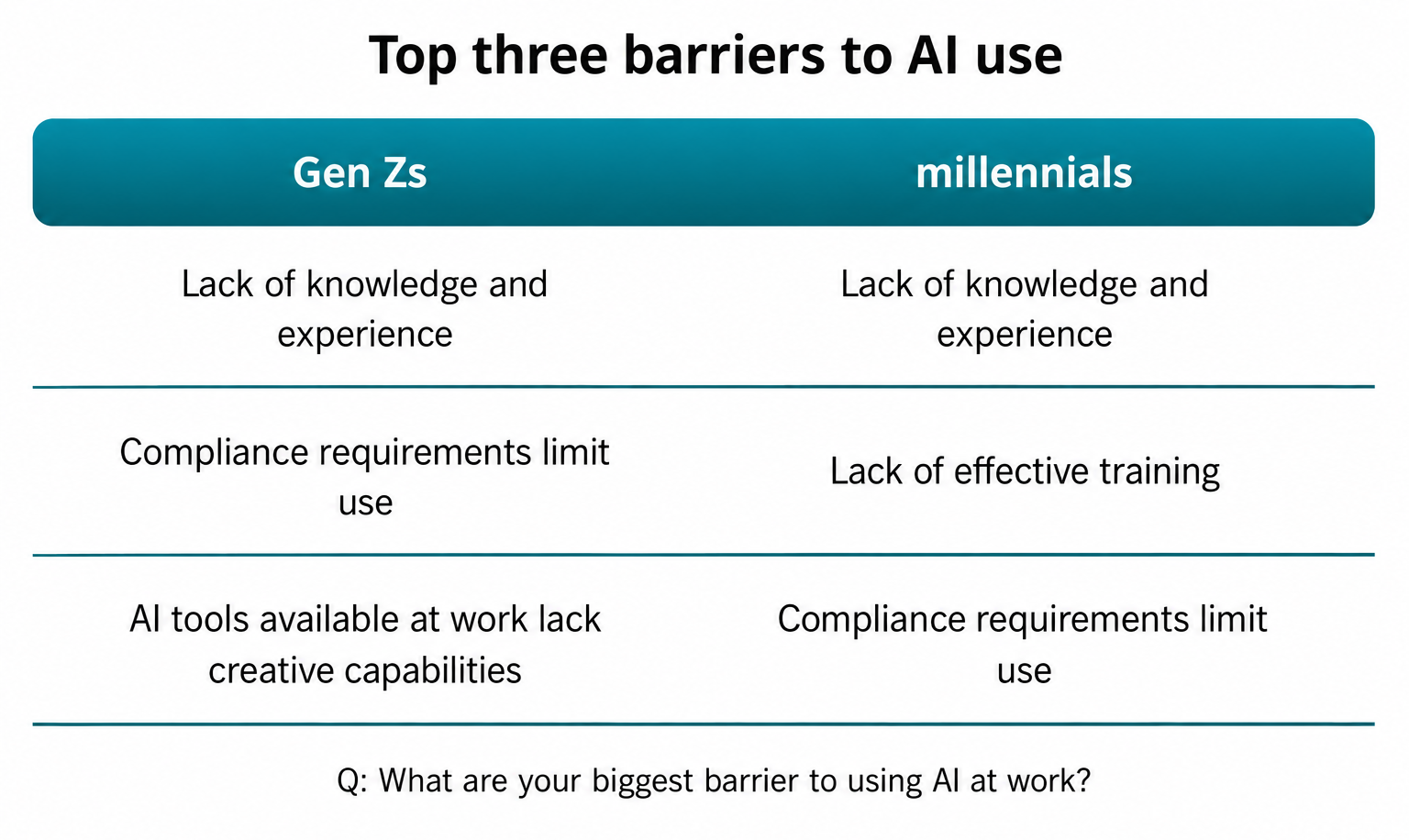
There’s an AI-readiness gap between workers and their organisations. Gen Zs and millennials feel they are adapting faster than their employers, as nearly one-third believes their organisation is not prepared for the changes AI will bring (30% of Gen Zs; 31% of millennials), and another one-third says the AI tools available to them at work are only somewhat or not at all sufficient (33% of Gen Zs; 32% of millennials).
In a work environment shaped by technology, digital overload is a risk. More than half of respondents (58% of Gen Zs; 54% of millennials) report experiencing digital fatigue from constant alerts, tool switching, and multiple platforms.
Source: 2026 Global Gen Z and Millennial Survey, Deloitte Touche Tohmatsu Limited
A GENERATIONAL TRANSITION IS APPROACHING
As baby boomers retire, organisations face mounting pressure to preserve institutional knowledge, all while preparing for the arrival of Gen Alphas, who are expected to enter the workforce in significant numbers by the end of the decade.
Knowledge loss is a real risk. Only 54% of Gen Zs and 60% of millennials say their teams could maintain performance if a key expert left tomorrow, citing limited incentives, time constraints, confidentiality concerns, and high turnover as barriers to effective knowledge sharing.
AI’s impact on hiring is evolving. Nearly a quarter (23%) of respondents say AI is leading their companies to create new entry-level roles, though some remain concerned about AI’s impact on jobs – 20% of Gen Zs and 17% of millennials say their organisations are scaling back entry-level roles.
Gen Zs and millennials are optimistic about entry-level career development. When asked how AI usage is affecting entry-level jobs within their organisations, respondents most often say it’s enabling entry-level employees to gain experience faster (26% of Gen Zs; 28% of millennials), allowing them to focus on higher-value work (25% of Gen Zs and millennials), and accelerating career growth potential (25% of Gen Zs and millennials).
GOING FORWARD
“Gen Zs and millennials are adapting to a world that has demanded resilience early and often. They are moving forward thoughtfully, selectively, and on their own terms. How they navigate uncertainty – how they define success, weigh tradeoffs, and engage with employers – will help set the norms that Gen Alphas encounter as they begin entering the workforce in a few years,” adds Ms Faber. “This underscores a broader reality: what generations need, want, and expect from their work will continue to evolve, and the organisations that keep up will be those willing to evolve with them.”
1 Gen Zs are typically defined as being born between January 1995 and December 2010 but this study does not include respondents younger than 18. Each year the definition of Gen Zs in the survey shifts a year to include all adult Gen Zs.
2 The regions span Africa, Asia Pacific including Southeast Asian countries like Indonesia, Malaysia, Singapore, Thailand and Vietnam; North and Latin America; Eastern and Western Europe, and the Middle East.