Over the past decade or so, globalisation, digitalisation and the integration of world economies have significantly increased the quantum of cross-border transactions, including the movement of goods, services, intangibles and talent. This growing integration and interaction between countries – all with different tax systems – has heightened the risk of profit shifting from high-cost to low-cost jurisdictions and tax base erosion, affecting governments, businesses, and individuals alike.
In response to the above, OECD has issued Base Erosion and Profit Shifting (BEPS) 1.0 in 2013, supported by 15 Action Plans, to curb tax avoidance, and ensure profits are taxed where economic activities occur. Building on this foundation, BEPS 2.0 was introduced in 2021, structured around two key Pillars which aim to stabilise the global tax framework and improve transparency.
Against this backdrop, PKF Singapore helmed the recent ISCA Lunch Talk, on August 13, to revisit the key principles of BEPS 1.0 and 2.0, and to take a deep dive into the practical implications for multinational enterprises (MNEs), including how MNEs can navigate local and global compliance obligations, enhance transparency and consistency in intercompany transactions, and manage the increased regulatory scrutiny and audits, to mitigate the risk of penalties and double taxation.
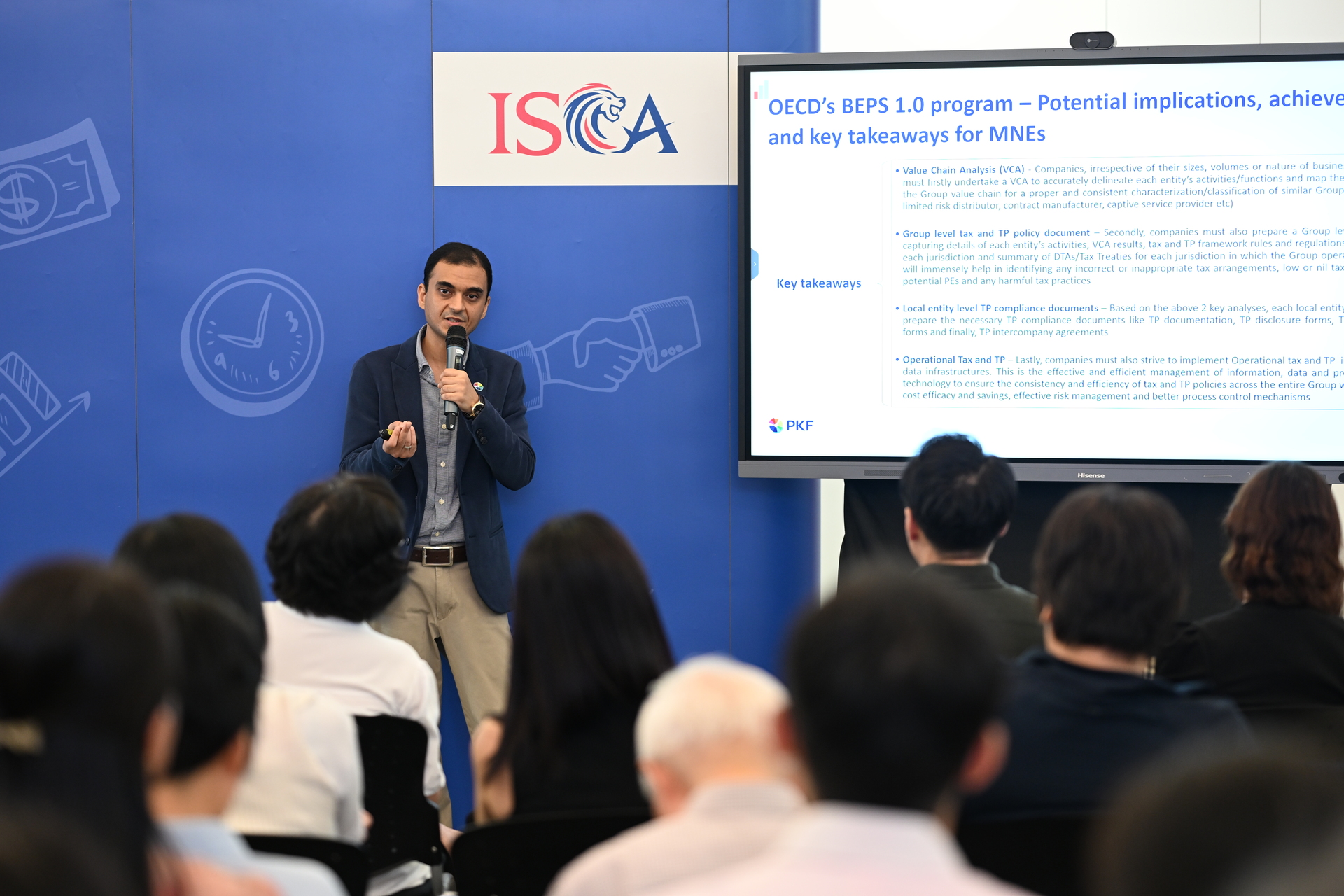
Presenter Sahil Seth, Director of Transfer Pricing, PKF Singapore, provided a brief background about the OECD BEPS 1.0 programme, namely, its history, 15 Action Plans, and potential implications and key takeaways for MNEs. He provided real-life examples to illustrate the points, sharing his practical experiences with the audience.
Mr Seth then outlined the OECD BEPS 2.0 programme, spanning its history and two Pillars, and what the potential challenges and key takeaways are, for MNEs. He also explained the importance of BEPS 1.0 and BEPS 2.0 and how the programmes are interrelated, as he expounded on the wider implications for other service domains like audit and accounting. The speaker then shared the probable action steps or approaches that can be adopted by taxpayers, to adequately and appropriately manage their intercompany compliance requirements.
The Q&A was a lively session with many attendees seeking clarifications on BEPS. Patiently and clearly, Mr Seth responded to them all before the close of the ISCA Lunch Talk, ensuring that everyone left the venue, ISCA House, with a better understanding of the session aptly titled “BEPS 1.0 and 2.0 – Key Transfer Pricing Implications for MNEs”.