
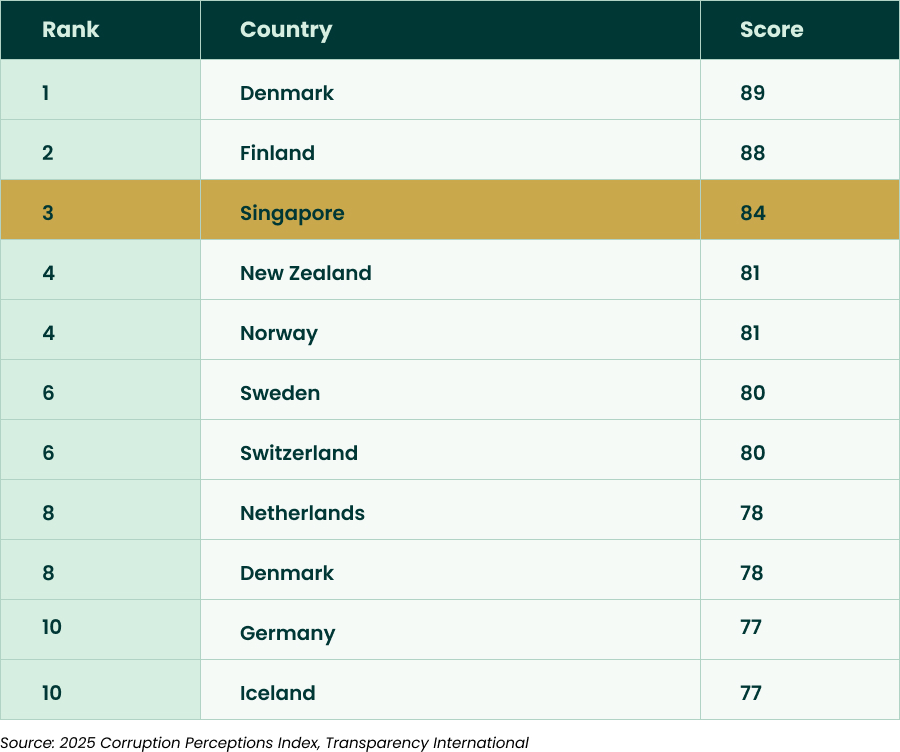
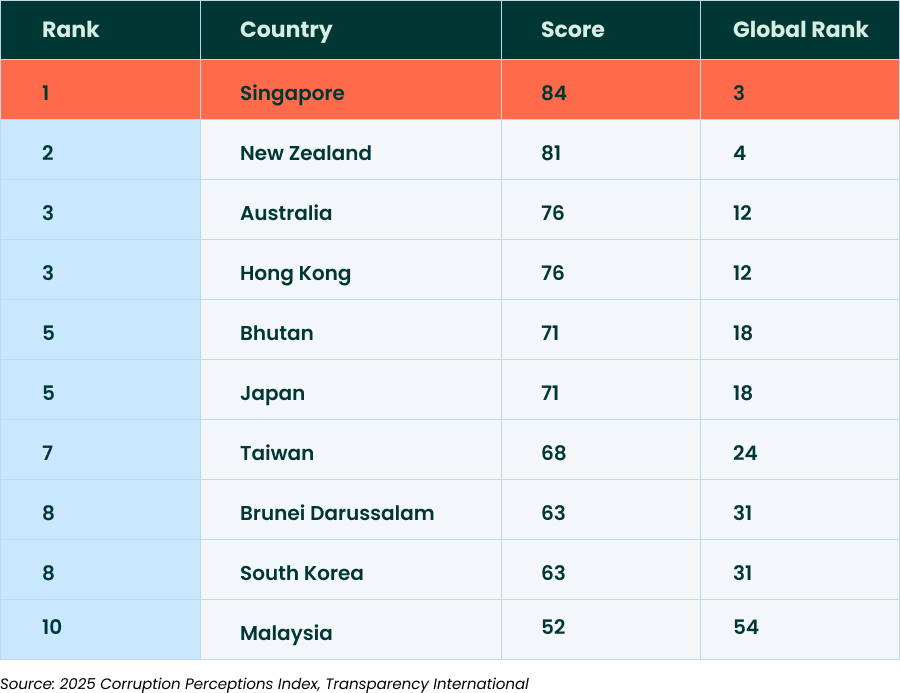
Singapore has retained its top position as the least corrupt nation in Asia Pacific, according to the latest 2025 Corruption Perceptions Index (CPI) report by Transparency International. With a score of 84 out of 100, Singapore is ahead of New Zealand (score: 81) in second place, and Australia (score: 76) in third, regionally.
On a global basis, Singapore stands in third place, New Zealand fourth, and Australia 12th. The CPI ranks 182 countries and territories by their perceived levels of public sector corruption on a scale of zero (highly corrupt) to 100 (very clean).
In Asia Pacific, anti-corruption progress appears to have stalled. With an average score of 45 out of 100, high levels of corruption have largely remained unaddressed over the past decade.
Frustration within the region at weak governance and limited accountability were clearly felt in 2025, with a surge in young people taking to the streets to demand action and accountability from their governments. In climate-change impacted Philippines (32), citizens were outraged by allegations that a substantial amount of public funds were lost to a fake flood relief project. In Indonesia (34), a dozen people died, and hundreds were injured as anti-government protests were met with violence and disinformation, while protest movements in Nepal (34) brought down the government following a widespread social media ban and growing frustrations around corruption.
Uniting these movements was a sense that those in charge were abusing their power for private interests, while failing to deliver decent public services, a stable economy and fair opportunities for citizens.
Countries such as Maldives (39), Vietnam (41) and Timor Leste (44), show a consistent and statistically significant upward rise since 2012, due to structural reforms that have strengthened oversight institutions, or in the case of Vietnam, due to effective management of petty corruption. However, these countries continue to score on the lower range of the index, with much room for improvement.
Elsewhere in the region, fragile states such as Afghanistan (16), Myanmar (16) and North Korea (15), continue to score at the bottom of the index. Restricted civic space, opaque political finance systems and a lack of democratic checks and balances and truly independent judiciary, continue to leave these countries particularly vulnerable to corruption.
“In many countries across Asia Pacific, good governance is being undermined by weak law enforcement, unaccountable leadership and opacity in political funding,” says Ilham Mohamed, Asia Pacific Adviser of Transparency International. “With young people demanding better, leaders must act now to curb corruption and strengthen democracy. Meaningful reforms can rebuild public trust and show those in power are finally listening.”
Since 2012, eight of the 32 countries have significantly improved, including:
Transparency International is calling for countries to implement a new UN resolution on preventing and combatting corruption through enhancing transparency in the funding of political parties, public office candidates and electoral campaigns, which countries adopted as part of the UN Convention Against Corruption conference in December 20251.
The Asian Electoral Stakeholders Forum in April 2026 is a key opportunity for election authorities to commit to the implementation of this resolution.
Related articles on CA Lab:
1 In December 2025, governments gathered in Doha for the 11th Conference of the States Parties (CoSP11) to the UN Convention against Corruption (UNCAC). Transparency International was among several organisations calling on delegates to commit to integrity in the funding of political parties and candidates.