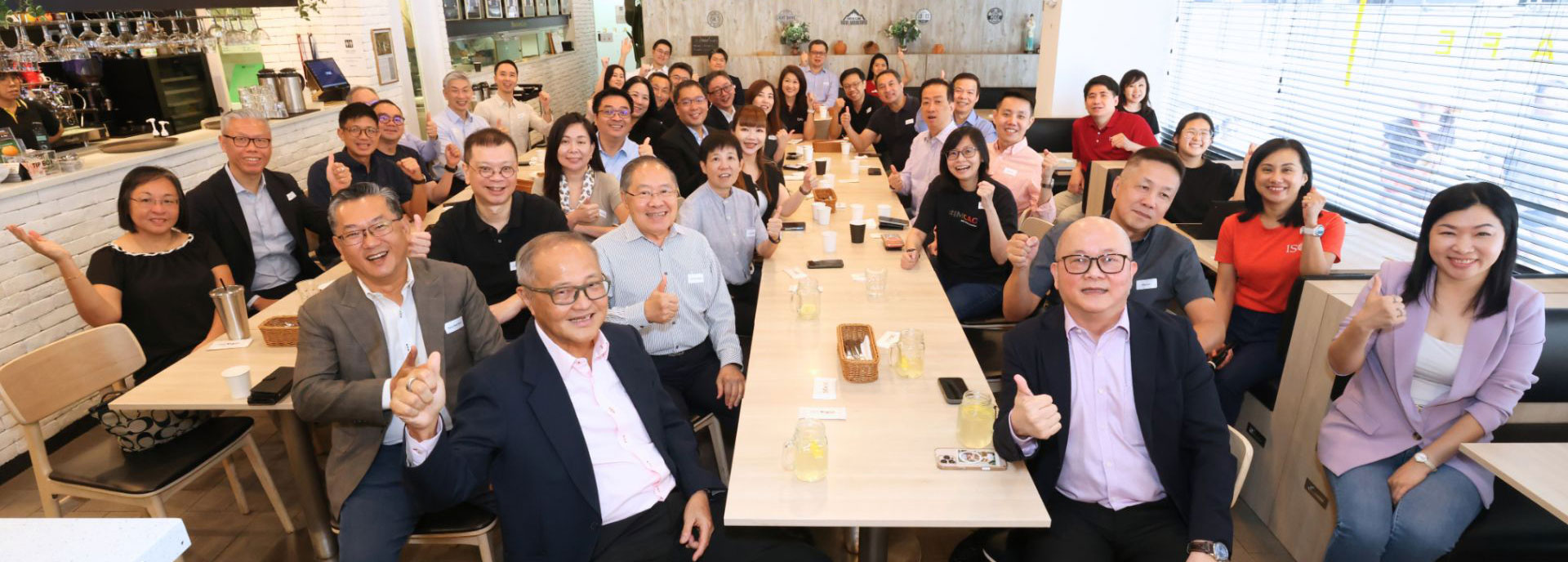
From a nine-year-old runner for a prawn noodle hawker to the founder of a global multi-brand empire, Mr Ron Sim (photo: centre table, front right) shares his tenets of survival: Courage, Creation and Commitment.
Today, he has a net worth of US$2.4 billion, according to Forbes, and is a business magnate with a hand in the wellness, lifestyle and real estate industries. Yet, 68-year-old Mr Sim never forgot the harsh circumstances that made him who he is today.
“We are lucky to be born poor,” he says. “It gives us the hunger and the desire to do things right.” Indeed, this would be the force that propelled the Founder and Executive Chairman of V3 Group Limited through 47 years in business – rising out of four recessions, crossing countless hurdles, building and rebuilding his fortune more than once.
Mr Sim was sharing his story at the third instalment of Leaders@Crossings on August 14. Organised by ISCA, the fireside chat series for C-suite and finance executives was held over breakfast at Crossings Café, a social enterprise that trains and employs disadvantaged individuals. The session was moderated by Mr Willie Cheng, an ISCA Distinguished Lifetime Member (photo: centre table, front left, opposite Mr Sim). What ensued was a morning of unscripted conversation and candid responses; and what emerged was an extraordinary lifetime’s worth of lessons, distilled into three recurring themes: Courage, Creation and Commitment.
At age nine, he was canvassing business at HDB blocks for a noodle stall, earning a few cents in commission for every bowl sold. By April 1979, Mr Sim was already launching his first company, R.Sim Trading. He had left a lucrative job selling household products at People’s Park to start a business venture selling household items to consumers. He was only 20 years old.
Young Mr Sim quickly saw the limitations of the domestic market, made more obvious by the 1985 recession. While others played it conservative, he went in the opposite direction. Exhibiting the same courage to explore new frontiers, he set his sights on the region. By 1987, he had moved into Hong Kong and Taiwan. Pivoting to healthcare and wellness products, and subsequently focusing on massage chairs under the new company, OSIM, he entered the US market in 1996.
Courage was also what helped pull him through some of his biggest trials. Just a few years after he bought American retailer Brookstone for US$475 million in 2005 as part of his expansion plans, the 2008 financial crisis sent Brookstone’s performance – and his own balance sheet – into a tailspin. The banks threatened to pull his credit lines, but he refused to back down. Instead, Mr Sim launched a $60-million rights issue and a personal guarantee to take up every unsubscribed share. He would emerge triumphant. “In the first quarter of 2009, the stock fell from $2.90 to 5.5 cents, but after that impairment, the next 24 quarters were all positive, and the stock recovered; it went back up to $2.80.”
If courage got Mr Sim into business, his insistence on creating something that he could call his own kept him there. “By the mid-to-late 1980s, I felt I needed my own brand rather than just selling other people’s products,” he recalls. This early realisation meant, for him, creating brands of value himself: first OSIM, and now, V3 – the conglomerate with a diversified portfolio of 11 brands across wellness and healthcare services, luxury gourmet, and real estate segments. The brands include OSIM, TWG Tea, and Bacha Coffee – each an original creation.
Creation, in Mr Sim’s telling, is never only about products. It meant building a genuine demand rather than borrowing somebody else’s. This distinction was proven during the COVID-19 pandemic. “The year 2020 was frightening. We had over 900 stores worldwide, and almost all of them closed overnight. That’s $60 to $70 million a month in rent and payroll, with close to zero revenue for about three months,” he recounts. The financial discipline built after the first crisis helped to sustain the business during three very tough years, but the bigger lesson was this, “Owning your own demand – your own brand – is far more resilient than distributing someone else’s products.”
Mr Sim’s courage to make the hard decisions and his drive to create businesses that are truly his own are underpinned by his commitment.
This meant staying loyal to the business when it could have been easier to walk away, such as when OSIM’s share price sank to 6 cents, and he was pressured by bankers to take the company private on the cheap. “I refused. I had over 3,000 shareholders who’d supported me, and taking it private that cheaply would have shortchanged them.” Instead, he waited years for a fairer valuation before delisting in 2016. “I eventually did it for around $1.30 to $1.35 a share, paying roughly $300 million-plus fees, financed mostly through a bank loan rather than my own cash. Over 16 years as a listed company, I raised $36 million going in but paid over $300 million coming out – a heavy price – but I believed I could run the company better privately.”
His commitment to doing right by the business has also pushed him to reskill. “Since then (the 2008 financial crisis), I’ve made it a point to understand finance as well as any CFO – sometimes better. So today, I’m about 80% CFO, not just a businessman or operator. I know how to structure things correctly, and legally,” he shares. “I still think of myself as a better businessman than a numbers guy, but I’m numbers-literate now.”
Mergers and acquisitions, and the process of delisting the company also pushed him to deep-dive into the workings of the stock market. “It forced me to understand the principles and psychology of the financial markets in real detail.” This commitment to betterment is perhaps why the boy who left school with just an ‘O’ Level certificate has been conferred an honorary Doctor of Philosophy in Business Administration from Wisconsin International University, and Doctor of Philosophy in Marketing Management from the American University of Hawaii.
This commitment also translates into accountability. Sparring with a member of the audience over whether Founder-CEOs should also chair the company board, he shares his view that the success or failure of a business often hinges on the calibre of the people steering it. To that end, Mr Sim opines that accountability matters not so much as a structural safeguard than as a personal trait. Indeed, his commitment to his shareholders, staff, and the businesses he has started is the rock that grounds him when he is faced with adversity. It is also the fuel for his dedication to creating unique brands that he would own, rather than simply distribute.
For the finance and business leaders in the room that morning, the takeaways were less about replicating Mr Sim’s specific decisions and more about absorbing his underlying instinct: that resilience is built long before a crisis arrives, and that the numbers, when necessary, are never the whole story.
Four recessions in, Mr Sim is no less hungry than he was when he first started out. And, even as he anticipates the next crisis, he is also raring to continue building his business. “I think I’ve got maybe another seven to eight years before I retire and, like Willie (moderator for the session), do nothing,” he says laughingly. “Right now, I still feel young!”