
TAKEAWAYS
Would you trust an AI-generated recipe to recreate your mother’s cooking? Is coding still worth learning if AI can already write the code for you? In an episode of CA Listen Sparkling Conversations, undergraduate Cassiopeia Henok, from City St George’s University of London, United Kingdom, put these questions to four #CAStars from ISCA’s Global Talent Programme (GTP) 2026, comprising:
What emerged was a group that was neither anxious nor uncritical of AI; instead, the soon-to-be accountants were just working out, in real time, where the line between delegating to a tool and thinking for themselves sat.
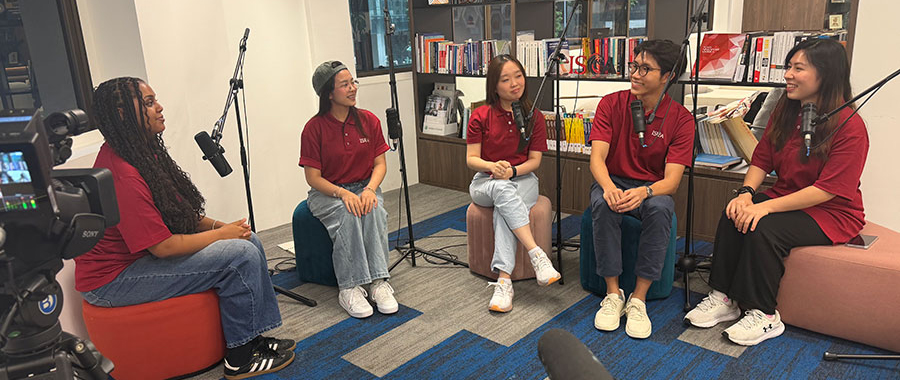
Pressed on which non-technical skills mattered more because of AI, the students kept returning to judgement. Industry leaders the group had met on company visits were consistent on one point – AI would not replace people, because it cannot replicate critical thinking and professional judgement. Jun Kye highlighted AI’s ability to translate a set of analysed numbers into something a client without a financial background can actually understand, while Pauline flagged that AI’s output still had to be checked, not trusted outright; she recalled instances of vouching that AI got wrong and a human auditor had spotted.
The ISCA #CAStars also converged on a less obvious skill: knowing how to ask AI the right question in the first place. As Khanh Van put it, “Prompting is as important as communicating.” Elvia quoted ISCA CEO Fann Kor who had said that the more you actually use AI, the more you notice it’s “hardly true”, unless you know how to prompt it well.
Asked what excited them most about AI in the accounting profession, Khanh Van compared having AI to having “a very small and a bit obedient assistant” that could clear repetitive tasks and free up time for higher-value work like discussing risk with a team. Elvia pointed to automation freeing up time for more valuable analysis, and to AI’s usefulness in flagging anomalies across large volumes of transactions that would otherwise need to be checked individually. Pauline described watching an AI agent handle vouching during the final months of an audit internship as “life changing”, after she had spent months doing it manually.
The students were asked to look five years into the future, and predict if AI would be a competitor, a tool, or an opportunity. Unanimously, they did not want AI to be an adversary. Khanh Van described treating AI as a teammate who can be consulted daily, even for things as small as recipes or personal advice, precisely because it doesn’t judge. Jun Kye argued that those who embraced AI would simply be better positioned than those who did not, and to treat it as a chance to build a new kind of fluency rather than a rival to compete with. Pauline shared a mentor’s advice, that relying on AI passively could make you “dumber”. But, if you treated it as a sparring partner whom you could challenge, it could sharpen critical thinking.
The students’ most memorable stretch of conversation had nothing to do with spreadsheets.
Would they trust an AI-generated recipe from their home country, if they couldn’t reach family members to verify it? Khanh Van recalled trying to recreate her mother’s braised pork dish at midnight, during her first year at an overseas university. The AI-generated recipe worked, until a call home revealed it had missed one ingredient: caramelised sugar. “That’s the moment I realised ChatGPT could actually help me,” she said. “But AI cannot replace everything, like revered family recipes, traditions, and the feelings of human beings.”
Others agreed the gap wasn’t really about instructions, but about feel. Singaporean Jun Kye pointed to hawker-style cooking, where seasoning is added “by feel” rather than a fixed measurement, which is something no AI-generated recipe can specify. Pauline described a cooking challenge where an AI recipe for a simple bake went wrong in execution. She concluded that AI can tell you what to do, but it cannot replace the hands-on skill of actually doing it. When the conversation circled back to day jobs, they agreed that the same principle applied in accounting, where the technical answer was seldom the complete answer.
On whether relying on AI for ideas will make everyone’s output converge, the consensus landed firmly in the middle. If AI-generated ideas were treated as the final answer, the outputs would look alike. But if they were used as a basic starting point to challenge and build on, the results would quickly diverge. The ISCA #CAStars added that different AI tools would produce subtly different outputs even for the same prompt; the real differentiator hinged on how specifically and personally a person prompted it. As Pauline said, the goal was to control AI and not let it control you.
When asked whether coding is becoming less important now that AI can write codes, the group pushed back hard on the premise. Coding teaches a logical, process-driven way of thinking that transfers directly to accounting and, without it, spotting when AI has got something wrong becomes much harder. The host shared a personal example from studying computer science at school, and emphasised that coding teaches a discipline that is totally absent in an AI “shortcut”. A single mistake can break the whole programme, and the learning comes when you have to debug it yourself. Khanh Van offered a simple analogy, that AI is like a GPS suggesting the route, but you still need someone who knows how to drive.
To every question, the group had a similar response. AI is fastest and most useful when it’s treated as a partner to think alongside – not a substitute for thinking itself. Whether the subject was audit vouching, a culinary recipe, or a line of code, the same idea kept surfacing – AI can get you some way there, but the last and most important step that counts is still the human one.
Also on CA Lab: