

TAKEAWAYS
Part 1 of this article explored why good people make bad choices. We saw how Marcus, a regional sales director, crossed a line not because he was corrupt, but because the system rewarded results without asking how.
But diagnosing the problem isn’t enough. It should come with the question, “What do we do about it?”
Most organisations respond with more rules – more sign-offs, more training, more declarations. And yet, the organisations with the thickest policy manuals often have the weakest compliance cultures.
Here’s the reality: if your processes make it hard to do the right thing, people will find workarounds. If your compliance programme fights human nature, human nature will win. The solution isn’t more enforcement; it’s better design.
Not all compliance failures are the same. Thus, the responses must not be the same either. Consider the following:
The response to each must be different. Intentional misconduct requires consequences. Process-induced non-compliance requires redesign.
Far too often, organisations treat all failures as misconduct. But if the root cause is friction, not intent, more rules just add guilt to the pressure.
The first step is to ask the question, “Is this a people problem or a process problem?”
Human-centred design (HCD) starts with understanding the people who use a system before designing solutions. It’s widely used in product design but rarely applied to compliance; that’s a missed opportunity.
When we design compliance processes without understanding the humans who navigate them, we create friction that breeds workarounds. We write policies for auditors, not for employees who face the grey zones.
HCD asks different questions:
Three tools are particularly useful:
An empathy map captures what a person in a high-risk role sees, hears, thinks, and feels.
This is likely a regional sales manager’s perspective:
This isn’t about excusing misconduct; it’s about understanding the environment that makes misconduct feel rational, so you can change the environment.
A journey map traces the steps through a high-risk process, identifying where friction occurs. Let’s look at a third-party vendor onboarding:
Journey mapping exposes where the process breaks, not because people are corrupt, but because the design doesn’t fit reality.
These are the important questions to ask when journey mapping:
A nudge is a small design change that makes the desired behaviour easier, without removing choice. Some examples are:
Nudges don’t replace controls, and they are not supposed to. Instead, they are intended to reinforce them by working with human behaviour. The best nudges are:
Third-party relationships are where corruption risk concentrates. Agents, distributors, consultants, joint venture partners; these intermediaries create distance between the company and the misconduct, and that’s precisely why corrupt actors use them.
The question isn’t whether you have a third-party policy; it’s whether your third-party process actually works.
Red flags to watch for:
Design questions to ask:

Identifying friction points is only half the battle; the harder part is convincing leadership to act.
The pitch isn’t “we need to be more compliant”. The pitch is:
Frame it as risk reduction and operational improvement; that’s how you get the buy-in.
A Chief Compliance Officer (CCO) must be empowered to not just design policies but to challenge the business, and CCO must also have direct access to the board.
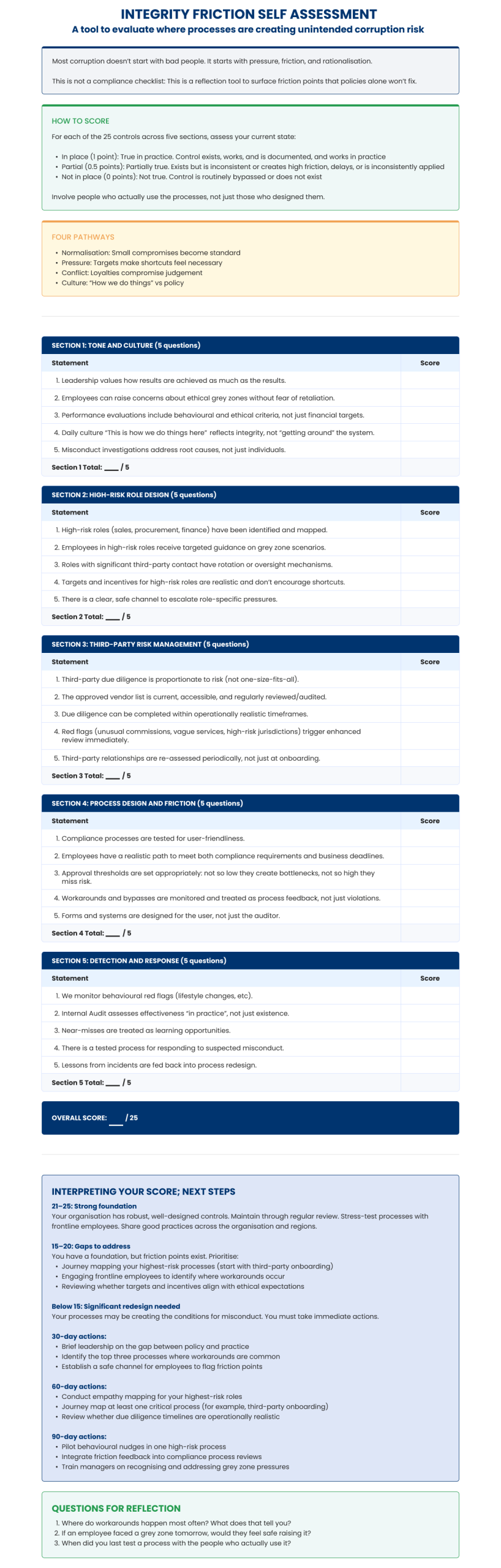
The Integrity Friction Self-Assessment is a tool for finance professionals to evaluate where processes may be creating unintended corruption risk. It examines 25 controls across five sections:
The goal isn’t to check the boxes; it’s to surface friction points that may be pushing good people toward bad choices.
Finance professionals see what others miss.
As auditors: Go beyond “Does the control exist?” to “Does the control work?”
As advisors: Help clients design compliance that fits operational reality.
As board members: Don’t just ask, “Are we compliant?” Go further with, “Where are we fragile?” Ensure the CCO has board access as well as the authority to challenge decisions.
As finance leaders: Recognise that every process you design either enables integrity or undermines it.
Neither enforcement, policies nor training alone will prevent corruption. What prevents corruption is designing systems where doing the right thing is easier than doing the wrong thing. This means:
At the highest levels, compliance is not only rules and enforcement as it is centred on stewardship. Boards and senior management must shape environments where doing the right thing is expected, supported, and sustainable.
The crucible of governance is ultimately tested in moments of pressure, and in how institutions respond, reform, and lead forward.
So, keep in mind that the question isn’t “Do our people know the rules?”. Rather, it is “Do our systems make it easy to follow them?”
Related articles on CA Lab:
Julia Chin is Founder/CEO, JFourth Solutions.